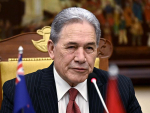
Winston Peters' FTA attacks 'just dog whistling' - Jacobi
International trade expert Stephen Jacobi says Winston Peters' objections to the Indian free trade deal are "ridiculous".




 increase font size
 NZ International Business Forum executive director Stephen Jacobi.
Much is at stake in the World Trade Organisation (WTO) ministerial meeting getting underway in Nairobi.
The meeting will affect New Zealand, developing countries and the multilateral trading system, says NZ International Business Forum executive director Stephen Jacobi.
The 10th WTO Ministerial meeting is being held in Nairobi from December 15-18 and will be attended by newly appointed New Zealand Trade Minister Todd McClay.
"As the pre-eminent body of multilateral trade rules and the arbiter of global trade disputes, the WTO is critically important to New Zealand," says Jacobi.
"Today the WTO's role in liberalising trade and eliminating trade barriers is being relegated to second or even third place as economies look to bilateral and regional agreements to boost trade growth. While regional agreements provide benefits for the participants, this approach risks leaving behind the world's poorest countries, which need the WTO to provide the means for them to compete on a more level playing field in global trade".
The WTO's Doha Development Agenda launched in Doha, Qatar in 2001 was dubbed a "development round" precisely to foster a more inclusive approach to trade and investment, says Jacobi. But Doha has languished since ministers came close but ultimately failed to conclude the round in July 2008.
"With Doha seemingly on a very slow burn, the WTO agenda risks becoming out of date as business models continue to evolve rapidly," he says.
"In a world of global value chains the time and cost of doing business is paramount. It is important, therefore, that the WTO members move to ratify the Trade Facilitation Agreement (TFA), concluded at last year's Ministerial in Bali two years ago. So far only 57 members (including New Zealand) have ratified and 108 ratifications are required to enable TFA to enter into force. If something as obviously beneficial as customs cooperation cannot be quickly implemented, it is hard to see how other more complex issues can be addressed".
Jacobi says regional agreements like the Trans Pacific Partnership (TPP) are not substitutes for effective action in the WTO.
"While regional agreements like TPP can help move forward the trade liberalisation agenda, they do not deal effectively with issues like agricultural and export subsidies which need solutions involving all trading partners," says Jacobi.
"Some might prefer it if these issues were never dealt with, but that is not likely to lead to concessions being made in other areas of importance such as market access for goods and services. Only a comprehensive outcome which delivers benefits for all participants is likely to achieve the consensus necessary to enable the WTO to move on to next generation trade issues".
Jacobi says that ministers are faced with a stark choice in Nairobi - having to wind up Doha at this point or re-committing to its conclusion in a specified time frame.
At the very least ministers need to come take significant decisions on other key issues on the Nairobi agenda such as the elimination of export subsidies, a package of measures to assist development and liberalisation of environmental goods and services, he says. A future expansion of the WTO Information Technology Agreement (ITA) covering trade in electronic products is also under consideration.
"Many in business have already given up on Doha, but they have not yet given up on the WTO. Hopefully something of the 'spirit of Paris' can flow over to Nairobi to show that multilateralism can work as much for trade as it can for climate change," says Jacobi.
"We wish Minister McClay and the New Zealand team well in Nairobi," he says.
International trade expert Stephen Jacobi says Winston Peters' objections to the Indian free trade deal are "ridiculous".

Leading trade analyst Stephen Jacobi has rubbished claims that New Zealand could have got a better free trade deal with India if it had prolonged the negotiations.
New Zealand’s top business leaders are urging the US Administration to review “unjustified and discriminatory tariffs” imposed on Kiwi exporters.
The recent squabble between the Cook Islands and NZ over their deal with China has added a new element of tension in the relationship between China and NZ.
The world is now amid potentially one of the most disruptive periods in world trade for a very long time.


High country stations, mixed sheep and beef farms, Māori-owned farms, corporates and family operations are among the nine commercial farms taking part in the Livestock Innovation Farming Transformation programme, known as LIFT.
OPINION: New health and safety guidance unveiled by the Government recently provides farmers greater certainty about what is expected of them when managing risks on farm.
The National Animal Welfare Advisory Committee (NAWAC) is seeking public feedback on proposed changes to the Code of Welfare for Rodeos.
A New Zealand initiative supporting farmers to restore the health of grazing landscapes has received international backing through the Regenerative Fund for Nature, a global collaborative fund supporting regenerative agriculture and the communities that produce natural fibres for the fashion industry.
Combine premium New Zealand products, blend in a family ritual and what do you get? A world-class functional drink.
Entries are now open across eleven regions for the 2027 New Zealand Dairy Industry Awards (NZDIA).




OPINION: The same mainstream media muppets that brought you Jacindamania in 2017 have been flat out pimping for the Opportunities…
OPINION: Your old mate reckons the atrocious way farmers in the UK are treated by their lords and masters in…




