Editorial: United strategy for wool
OPINION: Wool farmers believe the future of strong wool still holds promise.




 increase font size
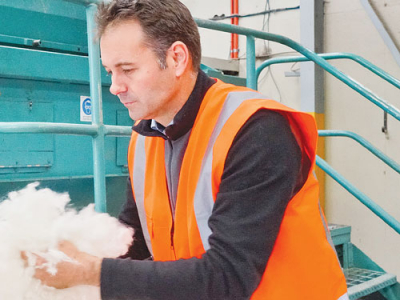 Wools of NZ chief executive Rosstan Mazey.
The last year has been “one of the most challenging for the New Zealand strong wool industry”, according to Wools of NZ’s latest annual report.
Nevertheless it had net revenue of $15.4 million – similar to last year – and operating profit of $142,769 ($150,583 last year) in the year to June 30, 2017.
The report says global demand for strong wool has continued to trend downwards. China, traditionally a big importer of NZ wool, has increased its domestic wool production.
NZ’s wool exports to China have decreased by 48% over the last two years, with volume down from 65m kg in 2014-15 to 34m kg in the 2016-17 season as local producers come on stream.
“The impact of this on NZ’s overall wool export effort is significant given China has traditionally represented a disproportionately large market for NZ wool The next-largest importer is the UK which took well under 10m kg this year.
Linked to this dramatic reduction, the NZ Wool Indicator has decreased in NZD by $2.35 in 2016-17 vs 2015-16, down from $5 to $2.65, the report says. The decrease has been exacerbated by the strong NZ dollar (NZD).
“Despite these challenging market conditions, Wools of NZ has worked hard to maintain contracted wool volumes with international partners and in securing forward contract prices in order to provide growers with an element of certainty in a vulnerable market,” the report says.
Chairman Mark Shadbolt and chief executive Rosstan Mazey last month told the annual meeting they were proud to deliver a positive financial result for grower shareholders despite the current state of the industry.
“These results are testimony to the merits of the strategic focus of the company over the last five years and the trust and confidence of our shareholders in that focus,” says Shadbolt.
“We have relentlessly pursued targeted investments in R&D, the development of new technologies that add value to our strong wool, the right partnerships, different routes to market, securing forward contracts for wool, ethical and sustainable production practices and building a compelling brand story.”
He says the company is in a strong position to further develop global commercial markets for initiatives and ground-breaking technologies such as Clacial XT and NuYarn and pursuing new initiatives through commercial success with NZ and international partners for the long term profitability of grower shareholders.
“Ongoing success will be greatly enhanced by choosing the right partners who share our drive to add value to shareholders’ wool and to work in collaboration.”
OPINION: Wool farmers believe the future of strong wool still holds promise.
Woolgrowers have almost unanimously voted in favour of the proposed merger of Wools of NZ (WNZ) and Primary Wool Co-operative- owned CP Wool (CPW).
Former Beef+Lamb chair James Parsons has been elected as chair of Wools of New Zealand (WNZ).
The Wool Summit had an air of collaboration and an understanding of the need to consolidate the industry, says Wools of New Zealand chairman Mark Shadbolt.



Waikato milk processor Tatua has again declared a record milk payout to farmer shareholders, leaving other processors in the dust.

A Labour-led Government won’t be bringing back the controversial freshwater rules of 2020.
National’s much-touted free trade deal with India featured in the Rural Issues Debate at Mystery Creek, Hamilton on Wednesday night.
New Zealand's 2026-27 freshwater fishing season has opened, with anglers encouraged to head to rivers and lakes over the coming days as conditions look favourable across much of the country.
Central Otago District Council (CODC) has voted against a plan to spread treated sewage sludge from Cromwell and Alexandra on farmland near Lauder, a decision Federated Farmers says reflects strong opposition from rural residents.
Pāmu has released its FY26 Integrated Annual Report, reporting a Net Operating Profit of $113 million, more than double the $49 million recorded in FY25.





OPINION: The same mainstream media muppets that brought you Jacindamania in 2017 have been flat out pimping for the Opportunities…
OPINION: Your old mate reckons the atrocious way farmers in the UK are treated by their lords and masters in…