
FAR Eyes NZ Grain as Dairy Supplementary Feed
Dr Scott Champion, Foundation for Arable Research chief executive, says that everyone in the supply chain had a role to play in driving the sector's long-term success.




 increase font size
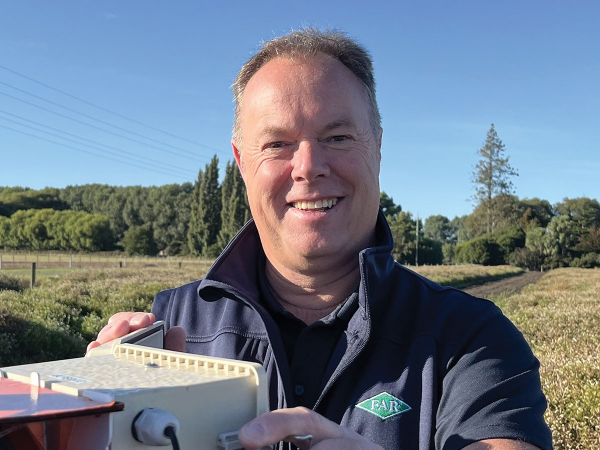 FAR technology manager Chris Smith.
With arable farmers heading into the busy planting season, increasing fuel and fertiliser prices, driven by the Iranian conflict, are a daily and ongoing concern.
While they have little control over pricing, FAR technology manager Chris Smith, says that making the most of a range of available tools to ensure that inputs are being used efficiently as possible will help address those worries. Many of these are already available in tractor cabs or farm offices.
"One of the most reliable places to start is with guidance and auto-steering technology, with manual steering inevitably meaning overlaps, often at 5 to 10% across a typical day's work. Auto-steer helps trim that down to between 1 to 3%. The small adjustment in accuracy can deliver a surprisingly large payoff, while straighter passes, besides looking tidier, also help reduce throttle variation, lower operator fatigue, and keep machinery working more efficiently," says Smith.
Smith says that those gains become even more pronounced when visibility drops, whether that's spraying at night, working with wide implements, or operating in the flat, hazy light that often blankets the Canterbury Plains. Typically, most users who move from a manual to an accurate guidance system can expect to burn between 5 and 12% less diesel over a typical season.
Chris notes such technology doesn't have to be expensive.
"Of course, not all GPS systems are equal, but choosing the ideal level of accuracy can prevent unnecessary spending. A range of offedrings include SouthPAN, which is free and works anywhere with a clear sky view, while delivering enough accuracy for mapping tasks and jobs that don't require precision."
Moving up a level, services like CentrePoint RTX offer near-RTK accuracy once they have converged, marking them ideal for spreading or spraying where consistent two-to-three-centimetre repeatability is valuable."
Smith explains that farmers wanting instant, high-accuracy performance for tasks like precision planting or strip-till will still find RTK difficult to beat; although they should realise that RTK will never pay for itself through fuel savings alone. Rather, its value comes from several factors including time savings, reduced overlap, less fatique, and the ability to manage inputs more precisely.
Product Placement Can Also Deliver Savings
Product placement is another area growers should be considering in terms of input efficiency, noting that even a basic guidance system can typically knock between 2 to 7% off chemical or fertiliser inputs.
When complemented by the addition of section control, it often delivers total savings of more than 10% once overlaps are removed on headlands and awkward field shapes.
The next real step change comes from variable rate application (VRA) that across typical New Zealand paddocks offers nitrogen savings of 5 to 20%, alongside phosphate and potash reductions by 10 to 25%. Results suggest that lime spreading is often the standout, with well-mapped paddocks showing reductions of 20 to 50% as over-supplied zones are corrected rather than blanket treated.
FAR technology manager Chris Smith says to make VRA genuinely effective, several data streams need to come together, such as soil sampling, canopy imagery, crop sensors, remote sensing, and yield maps to provide the guidance system with real intelligence.
"These layers feed into prescription software, where maps are turned into application zones and 'what-if' scenarios to estimate savings before any applications take place. Rate controllers, terminals, and ISOBUS systems then execute the plan, while as-applied maps and yield monitors show what happened post-event," says Smith.
"The cost of upgrading to VRA-capable equipment is typically around $20,000 over a standard machine, but payback can come surprisingly quickly."
In addition, users should also be considering optimum fertiliser rates, where those applying high rates to chase maximum yields, might be better off accepting lower yields, but increased margins.
Further points for consideration include choosing the right tractor or implement for a particular job. Many jobs simply don't require a large tractor, meaning that using less horsepower can cut fuel use by 20 to 40% on lighter tasks. The difference is easily demonstrated by comparing a 100hp tractor, burning 8 to 10 litres an hour, with a 200hp machine typically burning up to 20 litres per hour.
Tyre pressures are also an important consideration, reflected by correct inflation offering fuel savings of 5 to 10% in light duties or up to 20% in heavy draught applications. Constant monitoring means lower pressures in the paddock helps reduce wheel slip and improve traction, while higher road pressures for transport applications, helps reduce rolling resistance on the trek home.
"The key message is that small refinements, applied consistently, can deliver significant savings," says Smith. "All growers can implement some or all of the ideas suggested and, over time, move towards using them to their full potential."
Dr Scott Champion, Foundation for Arable Research chief executive, says that everyone in the supply chain had a role to play in driving the sector's long-term success.

Flat pricing in the face of significant increases in costs is the greatest problem facing the arable sector, says Foundation for Arable Research (FAR) chief executive Dr Scott Champion.
Four years since it was first detected in New Zealand, researchers and growers now know much more about management of maize pest fall armyworm (FAW).
Two Canadian spraying experts, Tom Wolf and Jason Deveau, are visiting New Zealand in early August to ensure that arable growers are hitting the target with this key piece of equipment.
Tickets are now available for the 2026 Arable Awards, set to be held in Christchurch on 20th August.


Dairy processors are ready to further boost New Zealand’s export earnings but want the incoming government to match their ambition with good policy.
Massey University is best placed to solve the “problems” facing the dairy industry, says vice chancellor, Pierre Venter.
Synlait's longest serving employee – a man who joined the Canterbury-based milk processor even before it began processing milk – is now its newest executive.
A dairy industry leader believes eradicating the common and costly disease, Bovine Viral Diarrhoea (BVD) is within reach.
A farmgate milk price of $10/kgMS this season is firming up as milk powder prices soar and the New Zealand dollar weakens.
Federated Farmers has welcomed new rural policies released by ACT, saying they align closely with its own election priorities.



OPINION: The same mainstream media muppets that brought you Jacindamania in 2017 have been flat out pimping for the Opportunities…
OPINION: Your old mate reckons the atrocious way farmers in the UK are treated by their lords and masters in…




