FAR Eyes NZ Grain as Dairy Supplementary Feed
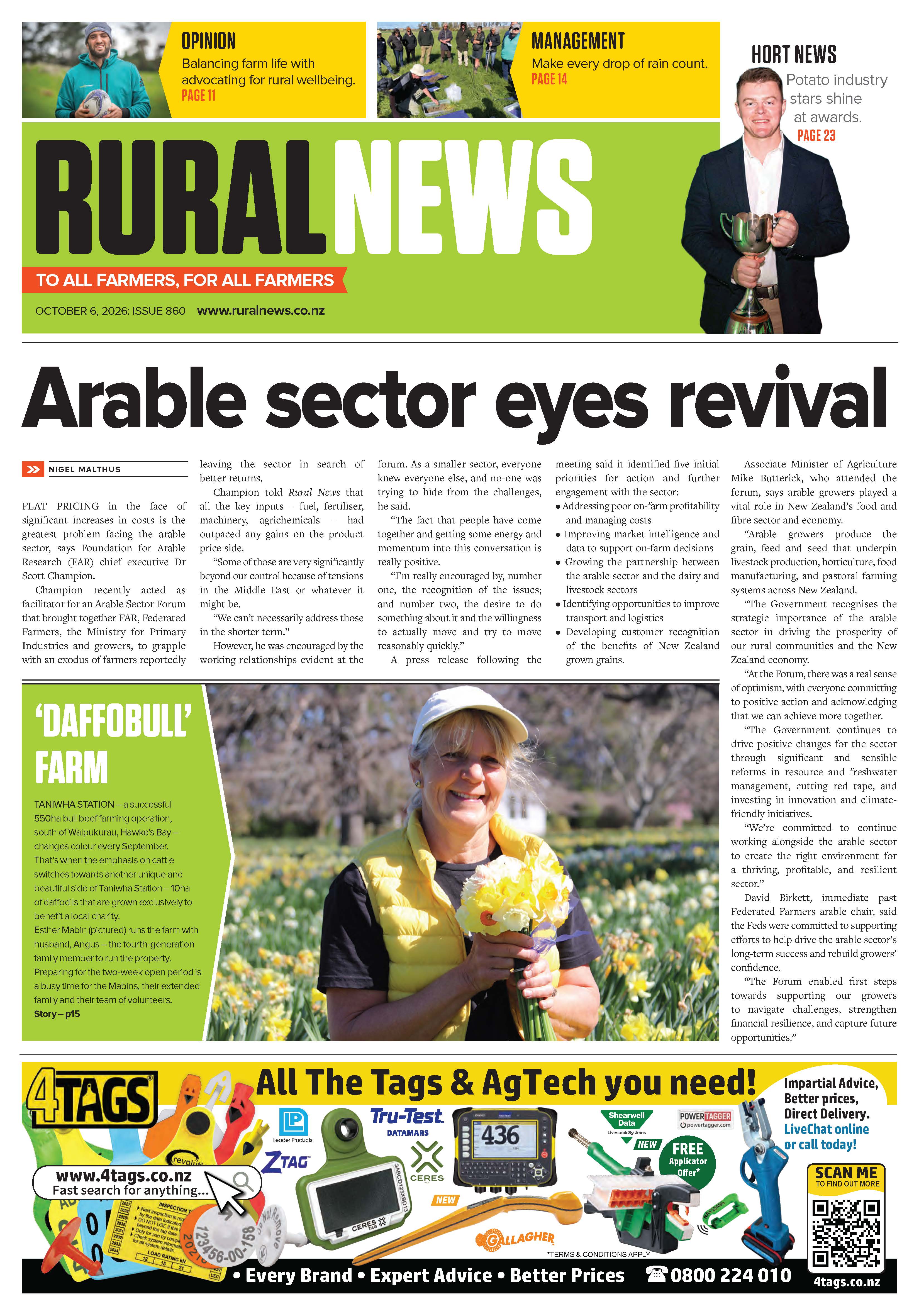
Dr Scott Champion, Foundation for Arable Research chief executive, says that everyone in the supply chain had a role to play in driving the sector's long-term success.




 increase font size
 Sprayers 101 presenters Tom Wolf, left, and Jason Deveau of Canada are speaking at a series of FAR grower workshops in August.
Two Canadian spraying experts, Tom Wolf and Jason Deveau, are visiting New Zealand in early August to ensure that arable growers are hitting the target with this key piece of equipment.
Crop spraying is an important job on an arable farm as it is vital that agricultural chemicals are applied accurately, not just to minimise inputs and costs but to avoid environmental affects such as spray drift.
Tom Wolf and Jason Deveau are co-founders of Sprayers 101, a non-profit, independent resource describing best practice in safe, efficient and effective agricultural spraying. As well as providing resources on their website, they also hold workshops which provide technical information to enable farmers and contractors to make the most of every spray application.
The Foundation for Arable Research (FAR) has organised a series of grower workshops with the pair throughout New Zealand from August 4 to 14. This follows the success of FAR’s combine workshops.
FAR technology manager Chris Smith says that spraying is one of the biggest investments growers make during a season.
“Small changes in how a sprayer is set up and operated can have a big impact on crop performance, input efficiency and environmental outcomes. These workshops are about giving growers practical knowledge they can apply straight away on their own farms.”
Tom Wolf says the Sprayers 101 workshops cover topics such as how to choose the right nozzle, how to minimize spray drift and how to get the timing right for fungicides.
“Our crops are valuable and we need to protect that yield and crop quality.”
The pair promise that the workshops will be fun and interactive, while seeking to solve growers’ spraying issues including water volume, droplet size and spray pressure.
As interest in spray drones continues to grow, two drone-specific workshops, at Leeston in Central Canterbury, and Ongaonga in Central Hawkes Bay, will give growers a deeper look at where drone applications may fit within arable systems, where limitations remain, and how to make evidence-based decisions around their use. For those unable to attend the drone workshops, key drone-related topics and insights will also be covered as part of the main Sprayers 101 programme.
Ahead of the workshops, the Canadian experts sounded a warning on drone spraying, with Tom Wolf saying he’s rarely been as conservative about a new technology.
“I have yet to see evidence that the drone advances the state of the art over and above what a (land-based) boom sprayer currently does.
“It does not necessarily advance drift management, which we fought hard to obtain through good stewardship and also to build trust with our client groups and the general public.”
Unlike the United States, Canada has only just started to relax regulations around the spraying of pesticides from drones, says Jason Deveau.
“Your swath, that is the width or the distance that you can reliably spray uniformly with as little variability as possible, is absolutely critical to drones working accurately.
“If you don't know how much area you've covered in a pass, if you don't know how much area is going to give you the efficacious result you're looking for, then that kind of variability is not what we're looking for in broadacre crops.”
Sprayers 101 workshops will be held on August 4 at Leeston, August 5 at Ashburton and Timaru, August 6 at Oamaru, August 7 at Gore, August 10 at Masterton, August 11 at Ongaonga, August 12 at Bulls, August 13 at Te Awamutu and August 14 at Te Puke. Additional drone spraying workshops will be held at Leeston and Ongaonga.
Register for the workshops on the FAR website, www.far.org.nz/events
Dr Scott Champion, Foundation for Arable Research chief executive, says that everyone in the supply chain had a role to play in driving the sector's long-term success.

Flat pricing in the face of significant increases in costs is the greatest problem facing the arable sector, says Foundation for Arable Research (FAR) chief executive Dr Scott Champion.
Developed in Australia and launched in 2021, John Deere’s See & Spray Select System uses camera-based green-on-brown technology to identify living green plant matter in fallow paddocks and apply herbicide only where it is needed.
Four years since it was first detected in New Zealand, researchers and growers now know much more about management of maize pest fall armyworm (FAW).
Tickets are now available for the 2026 Arable Awards, set to be held in Christchurch on 20th August.


Farmers are being encouraged to rethink how they manage waste on farm with the launch of ruralwastesorted.co.nz, a new website bringing together practical tips, real farmer experiences and resources.

New Zealand Winegrowers (NZW) is celebrating the India-New Zealand Free Trade Agreement (FTA) coming into force today, bringing New Zealand wine improved access to one of the world’s fastest-growing economies.
New Zealand’s red meat sector has welcomed the India-New Zealand Free Trade Agreement taking effect, which removes India’s 33% tariff on New Zealand sheepmeat.
More than 95 per cent of New Zealand’s forestry and wood exports to India can now enter tariff free as the New Zealand-India Free Trade Agreement comes into force today.
Federated Farmers is backing Feilding High School’s call to keep Agriculture and Horticultural Science as a standalone subject in Year 11.
Food and fibre exports have returned a billion- dollar bonus to the country.



OPINION: The same mainstream media muppets that brought you Jacindamania in 2017 have been flat out pimping for the Opportunities…
OPINION: Your old mate reckons the atrocious way farmers in the UK are treated by their lords and masters in…