We all know how important it is to get eight hours sleep, and while cows have different sleep patterns from us, they do need to spend a similar amount of time lying down.
But wet weather like we’ve been experiencing in some parts of the country can make lying down understandably less appealing.
For those of you using stand-off pads to protect your pasture, DairyNZ and AgResearch developed a simple test you can do with your gumboots and an online calculator to identify when it’s getting too damp and requires maintenance.
Research has found that when the moisture content of a stand-off pad’s surface reaches 75%, cows will stop lying down.
The Stand-off pad gumboot test and Tipping point calculator are both available on the DairyNZ website.
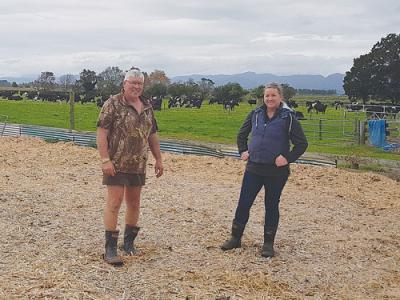
We tested the tools with farmers to ensure they made the grade. North Waikato farmer Phillip Buckthought and his contract milkers Brett and Bridget Dewar were among those to trial them.
Phillip, who has three stand-off pads on his Paeroa farm, tested the Tipping point calculator.
“It gives a really good idea of when you need to top your pad up with fresh wood chip,” he says.
“We have found post peel by far the best option, and it’s very important to scratch up when spreading it. As the old saying goes, ‘attention to detail’ is vital.”
Brett, Bridget and their staff trialled the gumboot test. Bridget went on the pads every day, and staff members once a week, to check with their gumboots how slushy or dry the pads were.
“The gumboot test gave us an earlier indication of whether we needed to give a stand-off pad a rest for a couple of days or a few weeks.
“With the new information, we rested one pad for a couple of days whereas before we would have kept using it. Doing it this way is better for the cows because they lie down more on the stand-off pad and less in the paddock – which is what you want,” Bridget says.
As part of the trial, they monitored for a week how long the cows lay down on the stand-off pads and in the field. The cows were on the pads from 3pm to 9am and on pasture for six hours.
“We learnt you have to watch the cows when they go out to the paddock. If they lie down it means they’re not resting on the pad enough.
“They should be eating when they’re in the paddock not lying down,” Bridget says.
“The gumboot test should be standard practice. It’s brilliant.”
For more information on managing stand-off pads, visit dairynz/stand-off-pads.
• Helen Thoday is DairyNZ animal care team manager.