
Boosting Crop Production by Spreading Effluent
Tararua district farmer Jamie Harris milks around 400 cows using a split calving system on his farm, Crossdale Dairies.




 increase font size
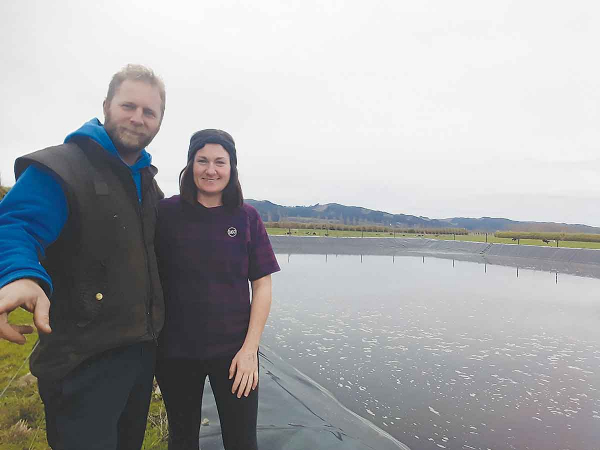 Michael and Rebecca Payne.
North Waikato farmers Michael and Rebecca Payne’s investment in a new effluent pond last year turned into a headache when neighbours complained about the smell.
The Waikato Regional Council was on the case and the Paynes were keen to sort the issue out quickly. That’s when the Otaua farmers decided to use BioMagic and its Impact effluent treatment. Today, the council case is closed and there are no complaints about odour from the effluent pond.
The Paynes decided to invest in an effluent pond early last year. With 200 cows on the 71ha farm, they are required under council regulations to have 90-day storage.
The new pond was constructed before the start of the 2019-20 milking in July. However, by September complaints were coming in from neighbours.
“There was no doubt that the smell was there, even we noticed the smell when the wind blew it towards out house,” Rebecca Payne told Dairy News.
“The pond had a thick foamy layer on the surface.”
The Paynes then decided to turn to BioMagic, who were very helpful.
Following treatment with Biomagic’s Impact, Rebecca says the foamy layer on the effluent pond disappeared and lots of bubbles were forming in the pond.
“There was certainly something happening in the pond,” she says.
But on Christmas Eve, the family was contacted by the council about fresh complaints from neighbours.
Rebecca says they contacted BioMagic again and worked with team to strengthen the dosage of Impact effluent treatment. This led to the elimination of the smell.
“The BioMagic team was great, they worked with us closely and followed up with weekly calls to check on progress,” she says.
“We were told that we left the treatment too late and this caused the foamy layer and the bad smell.”
Rebecca’s advice is that farmers should BioMagic from day one to be sure about keeping odour away.
She says the council has now informed them that the case is closed and there are no complaints from neighbours.
She thanked BioMagic for helping them out.
“They were a constant support with information and provided the extra strong products to help the situation.”
BioMagic says typical effluent ponds are dominated by anaerobic bacteria and its Impact treatment converts the pond into an aerobic state, dominated by aerobic bacteria.
These bacteria digest effluent up to 12 times faster.
Once digested, the effluent can increase the plant available nitrogen up to 300%, the solids and odour are substantially reduced.
Tararua district farmer Jamie Harris milks around 400 cows using a split calving system on his farm, Crossdale Dairies.
Water management is an integral component of sustainable farming practices, according to Watermetrics.
Two farmers and two farming companies were recently convicted and fined a total of $108,000 for environmental offending.
A Taupiri farming company has been convicted and fined $52,500 in the Hamilton District Court for the unlawful discharge of dairy effluent into the environment.
Founded in Germany as recently as 1977, today, the Fliegl Group employs more than 1100 workers, offering an expansive range of transport solutions, from their base in Bavaria.



National’s pledge to introduce 19 new national standards shows the party is serious about getting Wellington out of farming, Federated Farmers says.
The National Party’s policies to make it easier to grow fresh vegetables, secure reliable water and energy and simplify farm planning are practical changes that will give growers the confidence to invest, according to Horticulture New Zealand (HortNZ).
Fonterra Co-operative Group chief financial officer Andrew Murray has resigned to take up a role outside the dairy giant.
A major move is about to get underway to improve the quality and viability of dairy beef and cattle in NZ.
Veterinarians say changes to the code of welfare for dairy cattle provides a positive foundation for improved cattle welfare across the country.
Today, 15 October, is the International Day of Rural Women, which recognises rural women’s contribution to farming, communities and the environment.




OPINION: It seems Canterbury processor Synlait is still in the doldrums.
OPINION: Get offside with New Zealand First leader Winston Peters at your own peril.




