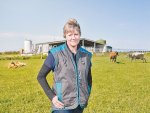
Freedom for cows, farmer
Southern Star Farms Ltd is a 456ha mixed farm near Waituna Lagoon, Southland, which runs 300 Jersey cows and 2500 breeding ewes.




 increase font size
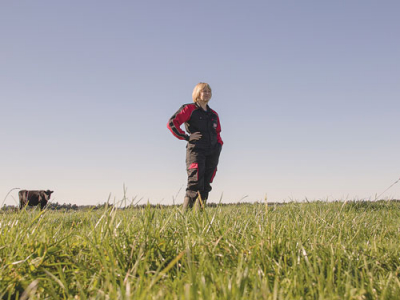 Joanne Crack looks after 300 cows by herself.
Southern Star Farms Ltd, an 85ha mixed farm near Waituna Lagoon, Southland, runs 300 Jersey cows and 2500 breeding ewes – a farm run seamlessly by Darrin and Joanne Crack.
She looks after the dairy side, where cows are milked by four Lely Astronaut A4 robots installed two years ago; he runs the drystock operation.
The concept of robotic milking is built around the cow: ensuring cows like to be milked -- different from conventional milking in many ways. The cows can be milked more in line with their natural behaviour.
To maximise the benefit of this concept an environment like the Cracks’ enables their cows to be milked at least twice a day and to graze when they like via the farm’s 100% pasture system.
Joanne says the most attractive aspect of converting to robots was her being able to look after 300 cows by herself, without any staffing issues.
“Fewer staff was among the most attractive aspects of a robotic system: I can look after my 300 cows by myself; I run our robotic dairy unit virtually on my own. I don’t need every second weekend off as it’s not physically demanding.
“I recently broke a bone and wrecked the ligaments in my knee but I was still able to run the robotic dairy unit, albeit much more slowly. I wouldn’t have been able to milk in a conventional system.
“I have help for calving and have someone to help with feeding the calves. Once the calves are trained I don’t need help with these as I have a Lely Calm automatic calf feeder.”
Discussing the benefits of their robots, Joanne says, “I don’t have to strip the colostrum cows. Of the 300 cows we calve down each season, not one is stripped unless the robot draws attention to the cow for mastitis or high somatic cell count.
“Of course if I have a cow that is not milking out in one quarter I will put her aside and check her. This season I checked or stripped about five colostrum cows. And I don’t use teat seal.”
The cows are always milked out properly, Joanne says.
“This was always the biggest issue of the herringbone; nobody wants to wait for a slow cow. Robots don’t mind and they take the cups off each quarter as it is milked out. This is impossible in a conventional system.”
Mastitis is lower in the herd, and so is drug use.
There is no need for changing milk lines between cows, fewer problems arise with sore feet, and the herd lifespan is longer due to the gentle treatment of the cows.
And the animals are all in one herd, Joanne says. “I find the heifers are able to compete with the cows in the robotic system far better than they did in the conventional system.”
With no ambition to milk more than 400 cows on their present platform, Joanne aims instead to improve milking times and the cows’ frequency of robot visits.
‘If they need me, they ring’
Spending just one hour in the shed each day, plus about 20 minutes setting up the four feed breaks for the day, Joanne now has the flexibility to get her jobs done when she wants to.
“I don’t have to do my jobs at the robot shed at 4am or any other regular time. If I’ve got plans for the day I do my jobs at a time that suits me. I’m often here at 7pm at night, but that suits me. It’s rare for me to be at my robot shed before 9am unless I’m going to be away for the day.
“There’s no need for someone to be there monitoring the robots. If they need me, they ring.”
Joanne is kept informed about the herd and individual cow performance by the Lely T4C management system which keeps track of each cow’s health and feed intake.
Southern Star Farms Ltd is a 456ha mixed farm near Waituna Lagoon, Southland, which runs 300 Jersey cows and 2500 breeding ewes.

High country stations, mixed sheep and beef farms, Māori-owned farms, corporates and family operations are among the nine commercial farms taking part in the Livestock Innovation Farming Transformation programme, known as LIFT.
OPINION: New health and safety guidance unveiled by the Government recently provides farmers greater certainty about what is expected of them when managing risks on farm.
The National Animal Welfare Advisory Committee (NAWAC) is seeking public feedback on proposed changes to the Code of Welfare for Rodeos.
A New Zealand initiative supporting farmers to restore the health of grazing landscapes has received international backing through the Regenerative Fund for Nature, a global collaborative fund supporting regenerative agriculture and the communities that produce natural fibres for the fashion industry.
Combine premium New Zealand products, blend in a family ritual and what do you get? A world-class functional drink.
Entries are now open across eleven regions for the 2027 New Zealand Dairy Industry Awards (NZDIA).


OPINION: It seems Canterbury processor Synlait is still in the doldrums.
OPINION: Get offside with New Zealand First leader Winston Peters at your own peril.




