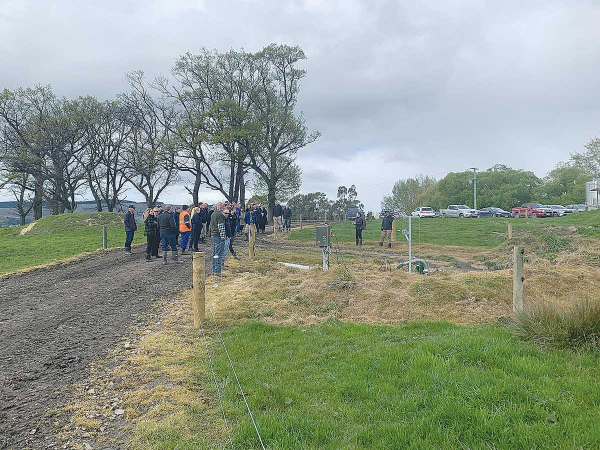
A recent field day in Otago to discuss looming new effluent storage and discharge rules attracted 50 farmers and rural professionals.
The field day at Scott Johnstone’s Moneymore Dairies at Milton was run by RDA Consulting, a regionally-based environmental consultancy firm.
RDA Consulting chief executive, Jason Harvey-Wills, told the farmers that RDA was happy to share information, assess issues and help farmers with solutions to get their environmental requirements dealt with.
“We are aligned and passionate about the primary production industry and are well set up with the right expertise, tools and track record from Southland to help them to implement changes required by both the new Otago effluent rules and the National Environmental Standards (NES) for freshwater management,” Harvey-Wills says.
Under the new rules recently notified Otago Regional Council Plan Change 8, farmers in the region will be required to prove that their effluent storage pond is sized in accordance with the dairy effluent storage calculator.
RDA Consulting project engineer Karen Ladbrook and environmental consultant Georgia Robinson spoke at the field day, explaining step-by-step how the Massey University dairy effluent storage calculator (DESC) works. The DESC is designed to determine how much deferred storage is required to hold effluent for those days when it is risky to apply effluent onto land.
“You should only irrigate effluent to land when conditions are suitable so that effluent does not run off to waterways or drain through the soil and contaminate groundwater. Ideally, you should be irrigating when effluent nutrients can be taken up by plants,” Ladbrook said.
The farmers had an opportunity to look at Moneymore Dairies’ effluent system starting at the cow shed, tracking the path of the effluent to the stone trap and sump, over to the sludge beds and out into the pond. Ladbrook emphasised the importance of having an operational management plan to mitigate risks identified for each of the components of the effluent system.
Robinson told farmers that under the recently notified rules, they will likely require a pond drop test if your pond does not have a leak detection system, is not of impervious concrete construction or is not an above ground tank.
The test uses specialised electronic probes to determine if gross leakage is occurring in an effluent pond.
She demonstrated the process of setting up a pond drop test and provided graphical examples of pass and fail results.
RDA Consulting senior farm environmental leader James Muwunganirwa says farmer feedback from the field day highlighted an increased understanding of the new rules and what they mean on their farm.
“At RDA we are seeing a continued need to assist farmers with the raft of new rules coming through from central government and regional councils.
“Plan change 8 is just one of these, but wetland identification, effluent system design, consenting, freshwater plans and water takes are all areas where we are seeing strong demand to help our clients.”
Muwunganirwa urged farmers to seek professional advice to understand their current situation and what they may need to do to meet the new requirements.
• For more information go to: https://rda.co.nz/otago-plan-changes/