Boosting Crop Production by Spreading Effluent
Tararua district farmer Jamie Harris milks around 400 cows using a split calving system on his farm, Crossdale Dairies.




 increase font size
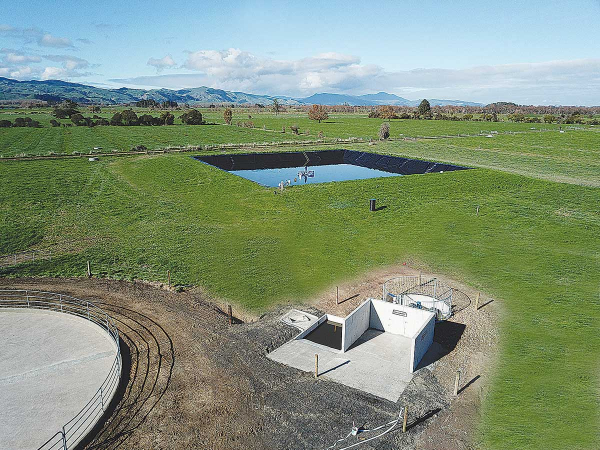
Williams Engineering Limited, based on the Hauraki Plains, has been producing high quality, practical and cost-effective farm machinery for the past 40 years.
With the agricultural sector realising that farm effluent is a resource rather than a nuisance, the company has changed its focus over the last decade completing training in farm dairy effluent system design and management in conjunction with Dairy NZ.
Around seven years ago, the company became Farm Dairy Effluent Design accredited. This allows Williams Engineering to design, install and commission a fully compliant effluent system from start to finish.
Over the past five years adequate effluent storage has been a big part of the business, starting with an onsite visit to develop a farm specific plan, utilising a range that includes precast in-house concrete panels for sand traps, bunkers and weeping walls etc, then specifying pumps, agitators, mainline systems, hydrants and a suitable irrigator for efficient application.
In the case of the irrigators, the Williams GB Magnum Travelling Rain gun Irrigator is the first of its kind, using a patented design to combine the performance of a static rain gun with the reliability of its Greenback travelling irrigator. The 8.5m wide boom can offer a wetted area of 45 to 90 metres, application depths of 3 to 25mm and handle flow rates up to 51,000 cubic metres/hour.
In particular, it delivers a wetted area that is more than twice as wide as a traditional travelling irrigator, with application rates and depths competitive with sprinkler systems
The Greenback Spider Travelling Irrigator can help increase pasture production utilising a simple speed change procedure with a choice of five travel speeds, allowing greater control of effluent application depths, with a minimum of 5mm, thus allowing greater control of soil absorption rates.
Tararua district farmer Jamie Harris milks around 400 cows using a split calving system on his farm, Crossdale Dairies.
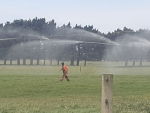
Water management is an integral component of sustainable farming practices, according to Watermetrics.
Two farmers and two farming companies were recently convicted and fined a total of $108,000 for environmental offending.
A Taupiri farming company has been convicted and fined $52,500 in the Hamilton District Court for the unlawful discharge of dairy effluent into the environment.
Founded in Germany as recently as 1977, today, the Fliegl Group employs more than 1100 workers, offering an expansive range of transport solutions, from their base in Bavaria.


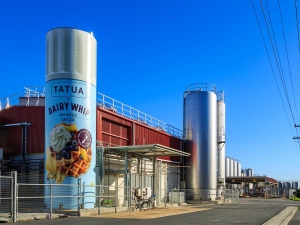
Waikato milk processor Tatua has again declared a record milk payout to farmer shareholders, leaving other processors in the dust.

A Labour-led Government won’t be bringing back the controversial freshwater rules of 2020.
National’s much-touted free trade deal with India featured in the Rural Issues Debate at Mystery Creek, Hamilton on Wednesday night.
New Zealand's 2026-27 freshwater fishing season has opened, with anglers encouraged to head to rivers and lakes over the coming days as conditions look favourable across much of the country.
Central Otago District Council (CODC) has voted against a plan to spread treated sewage sludge from Cromwell and Alexandra on farmland near Lauder, a decision Federated Farmers says reflects strong opposition from rural residents.
Pāmu has released its FY26 Integrated Annual Report, reporting a Net Operating Profit of $113 million, more than double the $49 million recorded in FY25.
OPINION: It seems Canterbury processor Synlait is still in the doldrums.
OPINION: Get offside with New Zealand First leader Winston Peters at your own peril.