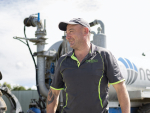
Boosting Crop Production by Spreading Effluent
Tararua district farmer Jamie Harris milks around 400 cows using a split calving system on his farm, Crossdale Dairies.




 increase font size
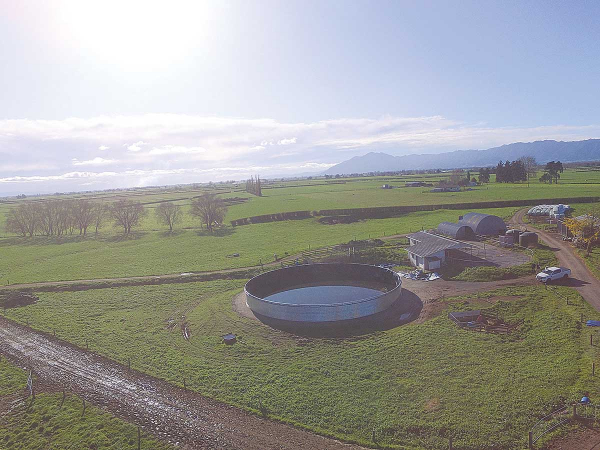 The industry cannot continue to allow effluent to leach into waterways or allow effluent odour to be the overriding smell on a summer’s day, says REL.
Mark Murphy, the national commercial manager for Rakaia Engineering doesn’t mince his words when it comes to effluent management.
“In the minds of the hardworking dairy community, effluent storage is a grudge spend at the very least,” says Murphy.
“They do understand, however, that intensive dairying has had a negative impact on our pristine land and waterways and what was once acceptable, is now no longer.
“We cannot continue to allow effluent to leach into our waterways or allow effluent odour to be the overriding smell on a summer’s day.”
Having undertaken two years of market analysis, paying attention to design and functionality, the research showed a real weakness with engineered plastics and typical wire bracing systems being too fragile and prone to bulging, which affected the storage’s structural integrity. It also indicated a lack of foresight with regards to the UV protection of the liners, with some liners becoming fragile and tearing away from the tank top cleats.
This drove REL Group to find the strongest structural steel sheets, matched with a liner that could withstand New Zealand’s harsh climate variances, while also incorporating liner slack to allow for constriction caused by frosts during winter. Alongside the need for strength, tanks needed to be environmentally secure and safe from an on-farm health and safety perspective.
“Our below-ground ponds are outdated, environmentally fragile and inherently unsafe, so we believe that above ground tanks are really the only viable option, as they mitigate vehicle submergence, effluent leaching to underground waterways and resisting floods that have the potential to allow effluent to escape into the surrounding countryside,” says Murphy.
The REL Group has released a new range of effluent storage solutions to meet the rapidly evolving sector. The heart of the system combines robust structural steel from AGI Westeel with a cutting-edge environmental liner from Layfield Enviroliners to create a secure storage solution that exceeds today’s requirements.
Fabrication modelling is said to allow easy install without the need for at height installation protocols, with the first two tanks being assembled in the Waikato during July. Additionally, the design of the system allows hardware to be disassembled, repositioned and reassembled on-farm as requirements change, or indeed, can be on-sold if enterprises change direction.
The remaining environmental issue of odour mitigation has been addressed by REL Group entering a supply partnership with Bauer to offer their separation technology and hardware, along with their irrigation product range to ensure a complete, turn-key effluent management system.
Splitting slurry into liquid and solid fractions sees the former being sent to storage and irrigation, while solids are rendered odourless and bulk stored for future distribution.
Murphy sums up: “’Dirty dairy’ is that nasty statement uttered by urban dwellers who have little appetite to investigate the veracity of urban media opinion pieces to understand its truth or origin. Education will not be enough to change the minds of our ‘woke neighbours’, so visual and physical evidence is the only tool available to the industry.
“The dairying industry must ‘do’ then ‘show’- matching our world leading farming systems with world leading environmental practices.”
Tararua district farmer Jamie Harris milks around 400 cows using a split calving system on his farm, Crossdale Dairies.
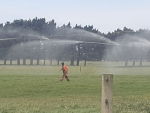
Water management is an integral component of sustainable farming practices, according to Watermetrics.
Two farmers and two farming companies were recently convicted and fined a total of $108,000 for environmental offending.
A Taupiri farming company has been convicted and fined $52,500 in the Hamilton District Court for the unlawful discharge of dairy effluent into the environment.
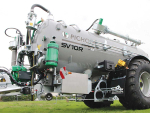
Founded in Germany as recently as 1977, today, the Fliegl Group employs more than 1100 workers, offering an expansive range of transport solutions, from their base in Bavaria.


National’s pledge to introduce 19 new national standards shows the party is serious about getting Wellington out of farming, Federated Farmers says.
The National Party’s policies to make it easier to grow fresh vegetables, secure reliable water and energy and simplify farm planning are practical changes that will give growers the confidence to invest, according to Horticulture New Zealand (HortNZ).
Fonterra Co-operative Group chief financial officer Andrew Murray has resigned to take up a role outside the dairy giant.
A major move is about to get underway to improve the quality and viability of dairy beef and cattle in NZ.
Veterinarians say changes to the code of welfare for dairy cattle provides a positive foundation for improved cattle welfare across the country.
Today, 15 October, is the International Day of Rural Women, which recognises rural women’s contribution to farming, communities and the environment.

OPINION: It seems Canterbury processor Synlait is still in the doldrums.
OPINION: Get offside with New Zealand First leader Winston Peters at your own peril.




