
Federated Farmers Backs Year 11 Agricultural Science
Federated Farmers is backing Feilding High School’s call to keep Agriculture and Horticultural Science as a standalone subject in Year 11.




 increase font size
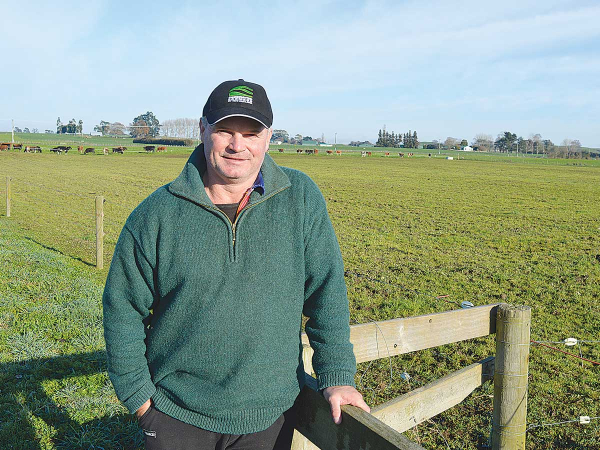 Andrew McGiven.
Two months ago, Andrew McGiven was planning a formal annual meeting and 75th anniversary dinner for Waikato Federated Farmers.
As outgoing Waikato Feds president, he was looking forward to handing over the reins to the region’s first woman president.
But Covid-19 threw a spanner in the works. Instead of a gala dinner, McGiven and Waikato Feds members conducted their annual meeting via online video conferencing site Zoom on April 30.
“How things can change in a short period of time,” McGiven said in his final report as president.
“Covid-19 will be remembered as the virus that stopped the world, and by extension New Zealand.”
McGiven, who farms in Te Aroha, believes Federated Farmers has become more relevant as politicians change their tune and look to agriculture to guide the country’s economic recovery.
“While our primary sector has been recognised as ‘essential services’, our economy has been effectively closed down.
“So, it is ironic that agriculture is now going to be relied upon to kick-start and save New Zealand’s standard of living, where only months ago we were being marginalised by all and sundry, especially politicians.”
McGiven notes that there will be some dark clouds on the horizon for New Zealand.
“For our pan-sector members, Federated Farmers will never be more relevant or necessary to keep all farming viable and sustainable.”
He thanked Feds’ 28-member policy and advocacy team for working in partnership with the board and national and regional elected representatives to get the best outcome for farming and agriculture.
He noted that Feds’ achievements during the year include campaigning against a capital gains tax.
“While the big cost of a capital gains tax would have been years away, all landowners (including small block holders) with over an acre of land would have been required to pay for a market valuation on implementation of the new tax regime.
“That’s your membership fee paid for the next four to eight years, let alone having to pay about 30% of the increase in the value of your farm to the government when you sold it.”
On the Government’s healthy waterways proposal, Feds successfully fought for an extension to public submissions.
“We will work with government in good faith, alongside farmer levy bodies, seeking to achieve a sensible, practical and affordable regulatory regime that has a fighting chance of achieving healthy waterways,” he says.
According to McGiven, other achievements of the Feds include working for farmers on biosecurity, streamlining compensation claims for M. bovis affected farmers, ensuring farmers could use .22 and semi-automatic shot guns for pest control on farms and improving the farm debt mediation bill.
Water quality is also a hot topic in Waikato; a decision on Waikato Regional Council’s Healthy Rivers Plan Change One is imminent.
“At this stage Waikato Federated Farmers is happy with the adopted framework of the plan, but still have some concerns around some of the limits and numerical bands set down,” he says.
“I was especially proud how our staff and members were able to present comprehensive submissions within a tight timeframe and I am forever hopeful that a sensible, practicable and affordable solution is found.”
Waikato Federated Farmers has also been heavily involved with MPI and Rural Support Trust in recommending a medium-scale adverse event be declared with drought conditions holding on to most parts of the Waikato until mid-April when some significant rain finally fell.
However, with many farmers having already fed out their winter and spring feed reserves, it could be a long and hard winter for some, especially with milk and meat price drops forecast, McGiven says.
He will remain on the Waikato Feds team as treasurer.
Federated Farmers is backing Feilding High School’s call to keep Agriculture and Horticultural Science as a standalone subject in Year 11.
National’s pledge to introduce 19 new national standards shows the party is serious about getting Wellington out of farming, Federated Farmers says.
Mobile phone coverage and reliability are deteriorating in rural areas, and farming families are bearing the cost, according to a Federated Farmers survey.
Central Otago District Council (CODC) has voted against a plan to spread treated sewage sludge from Cromwell and Alexandra on farmland near Lauder, a decision Federated Farmers says reflects strong opposition from rural residents.
Federated Farmers has called on Central Otago District Council (CODC) to drop or vote down a plan to truck sludge from Alexandra and Cromwell to farmland near Lauder, warning it would compound an "outrageous" situation created by a separate council's decision weeks earlier.



Alliance is calling for final applications for its 2027 Graduate Programme, with applications closing on Sunday 25 October.
Decades piloting planes has ensured vet and farmer David Hayes is focused on safety. So, after a serious accident while welding on farm, he is sharing his experience so others can learn from it.
Canterbury milk processor, Synlait Milk has confirmed Leon Fung as its chief executive officer.
OPINION: Making it easier to collect rainwater and use it to grow crops and livestock is a no brainer.
As part of its Election 2026 coverage, Rural News asked political parties how they would help pull the arable sector out of the doldrums. Here's what they said:
Farmers are being encouraged to rethink how they manage waste on farm with the launch of ruralwastesorted.co.nz, a new website bringing together practical tips, real farmer experiences and resources.



OPINION: It seems Canterbury processor Synlait is still in the doldrums.
OPINION: Get offside with New Zealand First leader Winston Peters at your own peril.




