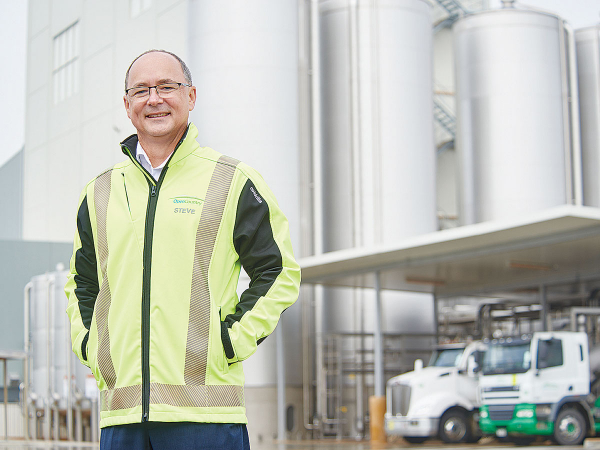
While no introduction date has been set, OCD chief executive Steve Koekemoer says this will be "a game changer" for the industry.
Open Country, the country's second largest processor, receives about 10% of the country's milk. Its 1,000 farmer suppliers get monthly advance payments for milk and paid in full on a quarterly basis.
Koekemoer says OCD's quarterly payments provide their farmers a significant cash flow benefit when compared to the traditional payment system used in NZ, where farmers wait until the end of the season before being settled for all their milk supplied.
"Our business model allows us to be very competitive on payout and pay quicker. We have always committed to return farmers' money to them faster and we will continue to innovate in that space. We see no reason to hold onto farmers' money when they can make better use of it," he told Dairy News.
The market price changes throughout the season and depends on the global supply and demand matrix for milk supply. "We cannot control the market price," Koekemoer says.
"What our payment system delivers is the fair value of milk at my point in time during the season."
OCD takes great pride in its relationship with farmer suppliers. Koekemoer, board chair Laurie Margrain and milk supply managers hold three rounds of 155 farmer meetings every year.
"We are not a co-operative but treat every farmer as a key stakeholder. We know that without farmers we don't have a business, it's as simple as that. OCD markets itself to farmers as 'a partnership by choice' and has never wavered from that position.
"We tend to work on the relationship quite strongly."
Proven Track Record
Open Country chief executive Steve Koekemoer says the company has an efficient business model with a proven track record. The business started 15 years ago and has never paid a dividend since inception.
"Every single dollar we've earned has been retained in the business over the last 15 years and this has allowed us to grow."
"We haven't had to pay our shareholders any dividend and our farmers are aware of that."
Open Country is 100% NZ-owned, owned by the Talleys family.
Koekemoer points out that all assets and staff are in New Zealand.
"We fly into overseas markets to do business. We may have some agents that work for us in markets but we've been very focused on keeping a NZ business and farmers enjoy that.
"A fully NZ-owned business that has grown rapidly into the country's second largest processor is nothing to be sniffed at."