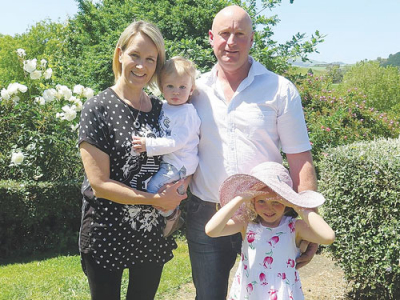

“I have a philosophy that we have to look beyond what we see and for the last five years I think we have achieved that on our farm,” he told the Environmental Defence Society’s conference’s discussion ‘The Future of Farming’.
He outlined the steps they took to improve the farm’s environmental performance; it won the Waikato Farm Environment Awards in 2016 while tripling production.
“When we looked at our farming practice – we own 245ha, 140ha of it a dairy platform -- we had to see ourselves as different from everybody else, with the mindset that we had to produce a product that was better, had a better story to it, had traceability that we could take to the world and the market and that somebody would be prepared to pay a premium for.”
They carried out a land use capability assessment on their farm.
“We worked out our farm’s contour, which was the best land to use for dairy and which was the best land to plant in trees.
“We have retired 20ha to manuka as a diversification, not to get rich out of manuka but to stop nutrient and sediment loss and to secure land which was marginal and probably shouldn’t have been farmed.”
Hayward says he was reassured when a woman who owned the farm 30 years ago showed him a picture of it 70 years ago; the land had manuka on it.
“It was a 70 year cycle for somebody to say ‘we need to change what we are doing’,” he says.
But they have also tripled production in the last five years from 70,000kgMS to 210,000kgMS.
“That goes down into our farming practice. We looked at our cows; we had Ferrari cows but they were producing like Minis. We needed to change that so we took control of what we were doing; we took control of our costs and instead of bringing maize in we grow it on farm. We use our effluent to grow our maize on farm.”
They also had to take control of their footprint.
“We had to understand our nitrogen footprint, how much P we were losing and our sediment, and what we could do to mitigate that. We have planted something like 30,000 natives on our property to make it better and create biodiversity.
“While I agree there are challenges out there, we are still an agricultural country. World population is growing… but we need to continue to grow a product someone wants to buy and pay a premium for. But our product has to be a premium product.”
Though there are challenges they are in “a really exciting place,” Hayward says. “I look at what else we are doing onfarm in regards to water. I sat on my phone here before (at the conference)… I can tell you now that we’ve had 25ml of rain, our cows have used 36,000 litres of water today, my milk is sitting at 3°C and the tanker hasn’t been.
“It is all information that is valuable so we can produce a product someone wants to buy and we have traceability.
“We have cut our PKE use in half and have the vision that in the next three years it will be gone…. We’ve embraced CRV Ambreed’s LowN Sires hoping that science is right and we can breed a greener cow which causes less nitrogen in our waterways.
“So all in all there’s heaps of exciting things out there – plenty of science we all need to just grab hold of and use.
“We need to be positive that our product can be premium and people will pay more for it.”