Ah Tatua, You've Done It Again!
Waikato milk processor Tatua has again declared a record milk payout to farmer shareholders, leaving other processors in the dust.




 increase font size
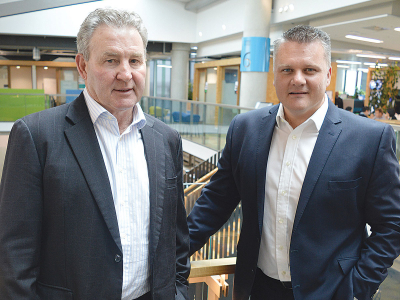 Fonterra chairman John Monaghan (left) and chief executive Miles Hurrell.
Fonterra says it has returned to profitability with a net profit of $80m for the first half of the 2019 financial year.
However, normalised earnings before interest and tax (EBIT) are down 29% on the same period last year to $323 million.
Fonterra chief executive Miles Hurrell says that while it is good to see the cooperative back in the black, the cooperative’s earnings performance is not where it should be and this was the reason for revising the full year earnings guidance down to 15-25 cents per share in February.
“The steady performance from New Zealand Ingredients in the first half of FY19 has been offset by challenges in Australia Ingredients and this has seen our total Ingredients EBIT decline by 17% to $461 million,” he says.
“Our Australia Ingredients business continues to feel the impact of the drought. We can see it in the decline of Australian milk collections and aggressive price competition for milk, which is resulting in the underutilisation of manufacturing assets and tightening margins.”
Consumer and Foodservice is tracking behind last year with an EBIT of $134 million. This part of the business has been held back by disruptive political and economic conditions as well as high input costs in Latin America.
Hurrell says in addition, in the China Foodservice business, demand slowed due to higher prices and in-market inventory levels growing for butter at the end of FY18.
“In Sri Lanka, our performance was impacted by price constraints.”
Hurrell says the focus is to meet the earnings guidance, deliver the three-point plan and fundamentally reset the business so it can deliver sustainable earnings.
“We have a forecast Farmgate Milk Price of $6.30-$6.60/kgMS but we also have to meet our earnings guidance range of 15-25 cents per share. This range builds in an expectation of a slightly softer second half for our Ingredients business, but a meaningful increase in Consumer and Foodservice earnings,” says Hurrell.
“Our forecast increase in our Consumer and Foodservice performance is based on a few key factors. It needs a strong improvement in our Foodservice business in Greater China, stronger consumer demand for Soprole in Chile and chilled dairy in Brazil, and an improvement in our Sri Lankan business.
“Our three-point plan involves taking stock of our business and conducting a portfolio review, getting the basics right and improving our forecasting. We’ve made good progress so far and we will continue to take these steps in the second half to firm up our foundations and strengthen our balance sheet.
“The second half will also see us continuing the work on developing a new strategy to support a much-needed change in direction. We are doing the right things but it’s clear more is needed to lift our performance. We need to simplify and improve the co-op so we can grow value.”
Waikato milk processor Tatua has again declared a record milk payout to farmer shareholders, leaving other processors in the dust.
Fonterra has unveiled its annual results for the 2026 financial year, posting $27 billion in revenue and close to $20 billion returned to New Zealand farmer owners and unit holders.
Fonterra Co-operative Group has confirmed the independently assessed candidates standing for election to its board in 2026.
Fonterra has revised its Farmgate Milk Price forecast for the 2026/27 season, lifting the midpoint and narrowing the range on the back of improving global dairy commodity prices.
Outgoing Fonterra Co-operative Council chair John Stevenson says that it has been a privilege to represent the co-op's farmer shareholders.


Farmer-owned fertiliser company, Ballance Agri Nutrients is welcoming National’s plan to negotiate security agreements with key supplier countries to protect New Zealand-bound products from export restrictions and greater supply chain certainty.

Carrfields has announced the appointment of Stu Hall to the newly created role of chief operating officer, Carrfields Ltd, reflecting the continued growth of their agribusinesses and the need to ensure the company has the leadership capacity and support in place as it pursues the emerging opportunities ahead.
New Zealand's role is not to compete with Indian growers, according to NZ Apples and Pears.
The potato industry is celebrating the success of two rising stars - James Blair, the 2026 Young Grower of the Year and runner-up and innovation award winner, Amber Davy.
Twenty-eight emerging leaders from across the horticulture sector spent two days last month learning valuable skills and connecting with industry experts.
There are five entrants in this year’s Young Horticulturist of the Year, competing in a series of technical, practical, business and leadership challenges.

OPINION: It seems Canterbury processor Synlait is still in the doldrums.
OPINION: Get offside with New Zealand First leader Winston Peters at your own peril.