
Boosting Crop Production by Spreading Effluent
Tararua district farmer Jamie Harris milks around 400 cows using a split calving system on his farm, Crossdale Dairies.




 increase font size

Two farm workers have been fined $24,700 for breaching effluent management rules.
A Opotiki dairy farm manager and senior farm assistant were found guilty of breaching the Resource Management Act after a week-long trial earlier this year.
An effluent irrigator failed and discharged waste into a nearby drain. Charges were also laid against the landowner and consent holder, who was previously found guilty and fined $30,000 for the same offences.
The failure happened on October 18, 2016, the same day a Bay of Plenty Regional Council compliance officer was doing a dairy inspection at the property. The officer arrived to find the irrigator located within spraying distance of a spring-fed drain. He also saw signs of effluent having flowed over the bank and into the drain which flows into the Waiaua River, and on to reach the coast about 10km east of Ōpōtiki.
A water sample taken from the receiving drain on the day of the event found the water had a high faecal coliform reading of 64,000 per 100ml -- 640 times higher than the recommended maximum level for safe stock drinking water.
Regulatory compliance manager Alex Miller says it’s well known that effluent irrigators, if not managed properly, can endanger the health of waterways.
“In this case the irrigator was placed close to a waterway, despite conditions in the resource consent prohibiting it. Once the irrigator was turned on, a mechanical failure occurred and, without fail safes on the irrigator, it stayed where it was. This led to the effluent building up and running down the bank into the drain,” says Miller.
“While not intentional, this case serves as a reminder that farm staff must be aware of the environmental risks with equipment. They must take the necessary steps to avoid situations like this, particularly when using outdated equipment,” says Miller.
Environment Court Judge David Kirkpatrick noted that the farm worker was “careless to a relatively high degree”.
Tararua district farmer Jamie Harris milks around 400 cows using a split calving system on his farm, Crossdale Dairies.
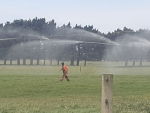
Water management is an integral component of sustainable farming practices, according to Watermetrics.
Two farmers and two farming companies were recently convicted and fined a total of $108,000 for environmental offending.
A Taupiri farming company has been convicted and fined $52,500 in the Hamilton District Court for the unlawful discharge of dairy effluent into the environment.
Founded in Germany as recently as 1977, today, the Fliegl Group employs more than 1100 workers, offering an expansive range of transport solutions, from their base in Bavaria.



In Dacre, near Invercargill in New Zealand’s South Island, Bruce Dinnington is running a dairy operation unlike any other.

A free online platform aggregating governance vacancies across rural and regional New Zealand has been launched.
Environment Minister Nicola Grigg has announced details of a new rural plastics recycling scheme.
Agricultural drone operators say that a government decision to allow lower-risk drone work without certification won’t lower standards but drive innovation and efficiency.
OPINION: Warning bells are ringing in the arable sector.
Farmgate lamb prices are down by 8%, beef cattle by 4.5% and farm expenditure up by 4.2%.




OPINION: It seems Canterbury processor Synlait is still in the doldrums.
OPINION: Get offside with New Zealand First leader Winston Peters at your own peril.