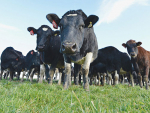
Mouldy feed threatens animal health
Mycotoxins threaten animal health and producer profits, so identifying and addressing these hidden challenges is important for farmers.




 increase font size
 Vaughn Holder, Alltech.
A new feeding programme designed by biotech company Alltech shows that with proper timing, nutrition can be a more powerful tool than genetic manipulation for controlling production, animal health and quality.
Alltech’s nutritional programme Epnix has yielded increased carcase weight, dressed yield and ribeye area in large scale trials, and it has been seen to remove antibiotics.
Dr Vaughn Holder, research project manager with Alltech’s beef nutrition department, speaking at the company’s ‘One 17 Ideas Conference’ at its Kentucky headquarters last month, discussed the trials conducted with the USA’s largest lotfeeder Cactus Feeders.
Epnix stems from Alltech’s nutrigenomics and epigenetics research work and provides a targeted nutritional approach to improving the carcase weight and performance of feedlot cattle independent of antimicrobial or beta-agonist supplementation.
Nutrigenomics is the study of how diet affects gene expression. Simply put, nutrigenomics looks at what a person or animal eats and studies how their body responds to it.
In 2008, Alltech opened the world’s first fully dedicated nutrigenomics and epigenetics lab.
It enabled the company to pinpoint the specific feed ingredients necessary to optimise lean tissue deposition.
Through nutrigenomics, the metabolic pathways crucial to muscle growth have been identified, allowing researchers to observe what has changed (increased weight gain) and why it has changed (improvements in energy metabolism); this led to the Epnix programme, which looks at providing the right blend of nutrients at the right time to encourage an animal to express its genetic potential. It includes a proprietary blend of ingredients and organic trace mineral supplements.
“Using nutritional interventions specifically targeted to each stage of production, we can achieve better health, improved performance and increased profitability,” Holder said.
“Through feedyard trials with Epnix, we have seen increased carcase weight up to 6.35kg and significant increases in dressed yield and ribeye area. This increases profit per head and ultimately improves the producer’s return on investment.”
Through its research, Alltech has been able to manipulate natural growth hormones and insulin receptors – central to the way Epnix operates.
“The technology conditions cattle to utilise finishing technology that will drive home feed efficiency, health, production and improved economics.”
Alltech began its large scale commercial research with Cactus Feeders in 2014.
They compared cattle on the Epnix programme with a control group on the Cactus Feeders ration. A second trial used the Epnix programme and removed antibiotics.
The control group contained trace minerals from mostly inorganic sources plus monensin and tylosin. Epnix diets contained organic trace minerals, yeast and bacterial preparations, but not monensin or tylosin. Both groups were fed for 165 days.
The group on the Epnix diet put on an additional 18kg of carcase weight, which Holder validated eight years of work.
The group of cattle on the Epnix programme minus antibiotics showed added profit of $4/head compared to the standard ration.
“For an operator like Cactus, that’s an additional $4m a year,” Holder said.
“You’d never take antibiotics out of a ration unless you had the incentive to do so or were forced to do so, but the option is there.”
• Alltech funded Stephen Cooke’s attendance at the conference. Ed.
Mycotoxins threaten animal health and producer profits, so identifying and addressing these hidden challenges is important for farmers.

A simple device underpinned by a complex algorithm can alert farmers via text message that a cow will calve within one hour.
Despite its large dairy herds, China is still a long way from self-sufficiency in dairy.
Alltech NZ has gained Ministry of Primary Industry registration for its longstanding product Mycosorb, which mitigates the adverse effects of mycotoxin in stock feed.
Is there a “seismic” shift in food choices and a demand for healthy, chemical free choices with transparency about where the food is sourced?


Pāmu has released its FY26 Integrated Annual Report, reporting a Net Operating Profit of $113 million, more than double the $49 million recorded in FY25.

Meat Industry Association data, released alongside the Red Meat Sector conference in Wellington, shows export value climbing across the US, China, UK and Canada.
Applications are set to open for the 2027 Zanda McDonald Award, a trans-Tasman award recognised for identifying and fast-tracking talented young leaders in agriculture and agribusiness.
The Royal New Zealand College of General Practitioners (the College) and Hauora Taiwhenua Rural Health Network are calling for investment in a proposed new training pathway for rural GPs, warning that many rural practices are struggling to recruit while a large share of the existing workforce nears retirement.
Federated Farmers has called on Central Otago District Council (CODC) to drop or vote down a plan to truck sludge from Alexandra and Cromwell to farmland near Lauder, warning it would compound an "outrageous" situation created by a separate council's decision weeks earlier.
Synlait has swung to second-half profit as operations stabilise, but the dairy processor still posted a $75.4m annual loss.

OPINION: It seems Canterbury processor Synlait is still in the doldrums.
OPINION: Get offside with New Zealand First leader Winston Peters at your own peril.