
Fonterra Expands Organic Dairy Programme Into South Island
Fonterra has announced it will continue with the planned expansion of its organic business into the South Island.




 increase font size

WHILE NOT classing his farm as organic, Andrew Fraser believes what you put into the soil is what makes the grass grow. He has always used reverted phosphate products and for seven years has added humates to his fertiliser and feed.
Andrew and his wife Clare farm in an equity partnership with Andrew's parents David and Glenis on both sides of the Pokuru Road, west of Te Awamutu, on the slopes of Mount Kakepuku. The farm has 313ha and 285ha each side of the road and a 56ha run-off 3km away.
"Our total farm is a third rolling and the balance flat and has three road underpasses, two river bridges and one road crossing to get stock to all paddocks," says Andrew.
The 840 Friesian-X cows are milked in a 50-bail rotary. He runs a split herd system with the younger cows (2- and 3-yr-old) getting a better start away from bullying older cows at feed time, drinking and in the yard.
They have a feed pad adjacent to the dairy shed and grow 17ha of maize annually which is fed on the pad from April-September. "We also use the feed pad for holding cows on wet days because when it gets wet here it really gets wet."
Fraser employs two full time staff and casual staff early spring. The dairy has automatic cup removers.
Last winter for the first time Fraser sent 225 cows to Hawke's Bay believing the season would be very wet. This proved correct and he was well satisfied. "It worked out well. They were away 10 weeks and came back in excellent condition as well as giving us here a little more room to move."
When feeding cows on the feed pad he adds some of Fertco's Mineral Boost, PKE and 50gm/cow/day of humates. And he adds humates 8% by weight to his bulk fertiliser. "I'm convinced adding it to the mix helps the fertiliser work better in the soil and it makes plant roots go deeper."
Fraser says adding humates to the total feed ration has many benefits including improved cow condition, fewer cleaning problems or metabolic troubles, and better cycling enabling him to further shorten the calving period for the following season.
"The farm has a low cell count – all part of feeding our cows better."
www.humates.co.nz
Tel: 027 275 5949
Fonterra has announced it will continue with the planned expansion of its organic business into the South Island.
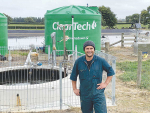
Ravensdown's ClearTech dairy effluent treatment system reduces phosphate leaching by an “astounding” amount, according to recent research.
Running an organic dairy farm is a bit like living on an island where one has to be completely self-sufficient.
Fonterra's record payout for organic milk reflects the value of being certified organic, according to Brendan Hoare, Buy Pure NZ managing director.
It’s official, Fonterra’s organic farmers have become the first in the country to receive a double-digit milk payout.

Federated Farmers has welcomed new rural policies released by ACT, saying they align closely with its own election priorities.
Rural Contractors NZ says proposed changes to land transport rules for agricultural vehicles are a welcome response by the Government to out of date regulations which have seen members hit with huge fines.
Alliance is calling for final applications for its 2027 Graduate Programme, with applications closing on Sunday 25 October.
Decades piloting planes has ensured vet and farmer David Hayes is focused on safety. So, after a serious accident while welding on farm, he is sharing his experience so others can learn from it.
Canterbury milk processor, Synlait Milk has confirmed Leon Fung as its chief executive officer.
OPINION: Making it easier to collect rainwater and use it to grow crops and livestock is a no brainer.
OPINION: It seems Canterbury processor Synlait is still in the doldrums.
OPINION: Get offside with New Zealand First leader Winston Peters at your own peril.




