Farmers can now order, initiate and record fertiliser and spray applications on their farms at the click of a button.
Precision Farming and TracMap Systems have joined forces to enable contractors with TracMap Systems in their vehicles to seamlessly receive application requests and send proof of placement records direct to the Precision Farming management software.
With TracMap fitted to about 70% of fertiliser spreading vehicles and many spray vehicles, and Precision Farming managing farm maps, it made sense to the two firms to set up the link, to make life simpler for farmers and their contractors.
“We didn’t see why contractors running TracMap Systems couldn’t provide the data they collected to Precision Farming customers whenever farmers wanted that,” says Colin Brown, TracMap founding director. We support Precision Farming in offering a more complete picture of onfarm activity to their clients.”
TracMap markets precision guidance systems to food producers originating in agriculture.
The system makes it easy to initiate jobs such as fertiliser spreading in targeted paddocks and have the drivers complete the work accurately and without mistakes.
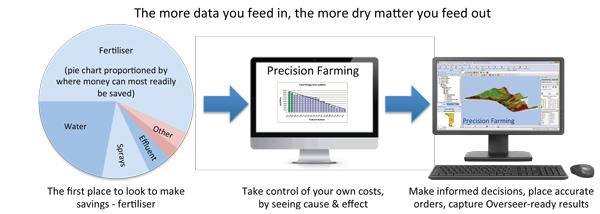
Precision Farming offers an integrated fertiliser ordering, recording, placement and NPK system using precision guidance, and it integrates other key information required by farmers to optimise pasture and crop performance.
Integration with TracMap will provide extra data and value to the Precision
Farming onfarm picture for farmers who request it, without requiring extra effort on behalf of contractors using the TracMap system.
Brendon Cane, managing director of Precision Farming, himself also a groundspread operator, says “Technology today enables much more value to farmers than having to go from system to system for bits of farm information. This collaboration with TracMap means now farmers and their agronomists can get complete access to pretty much all fert data in New Zealand regardless of who does their spreading, including self-spreading.
“And yet while fertiliser is one of the main cost centres in the operating expenses of a farm, it’s only part of the picture. Being able now to link fertiliser input costs with pasture production output value is a boost.”
How it works
Precision Farming, with TracMap and other partners, can capture most Opex applicaton data.
This brings together Precision and TracMap and other application data electronically (no need to type numbers into screens) into a single log-in system on PC, tablet or phone
Farmers decide on product then place orders electronically. These are accurate and immediate. Overseer-ready management information is captured while the work goes on.