
Pāmu FY26 Report: Profit More Than Doubles to $113m
Pāmu has released its FY26 Integrated Annual Report, reporting a Net Operating Profit of $113 million, more than double the $49 million recorded in FY25.




 increase font size
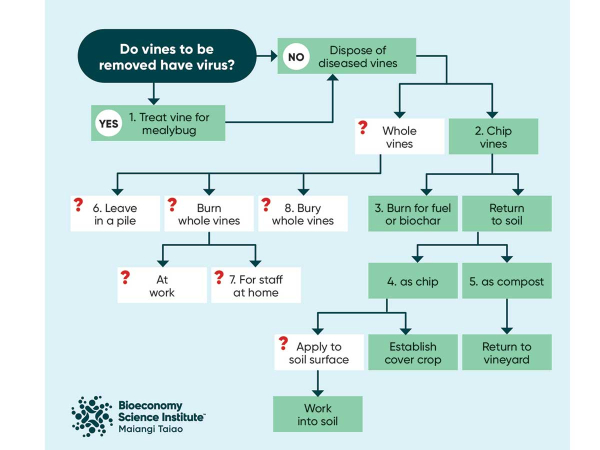 Options for consideration, with good hygiene in green alongside potentially problematic options in white
I am often asked by industry people, what are the options for removing a grapevine without producing a phytosanitary problem? Can it be done sustainably? What will it cost me?
This article describes some of the options and suggests some further reading. The best option will depend on your situation and resources.
Vines may be removed because of virus infection, grapevine trunk disease (GTD), or a change of land use. Some
of the options presented are more important if the land is replanted with grapevines. While in an ideal world all roots would be removed as well as the trunk, this is not always possible. Discussion is focused on trunk removal and preventing disease transmission.
Traditional practice has been burning or burial of grapevine remains. While these remain options as disposal methods, there are important considerations throughout the disposal process, as well as alternative options that offer their own advantages, limitations and cost implications.
If removing vines as a result of Grapevine Leafroll-associated Virus 3 (GLRaV-3), then it is advisable to chemically treat vines before they are removed so that any remaining roots in the vineyard do not support mealybugs as vectors. Any chemical treatment should be conducted with full understanding of current Sustainable Winegrowing New Zealand regulations.
When a vine (or other plant material) is chipped, it greatly increases the surface area, allowing a higher rate of decomposition. Chipping will also reduce the ability of cankers to produce new spores as new fruiting bodies will not be able to form on the uncolonised wood. One consideration for whole-vine chipping is the increased cost and requirement for specialised machinery with capital cost or contracting required.
If chipping is selected, vine material can be transported to specialist facilities, if available, where it can be used as a biomass fuel source or converted into biochar. These processes effectively destroy potential disease inoculum while creating value from what would otherwise be a waste product. The main limitation is transport costs.
Returning chipped vine material to the soil recycles valuable carbon and nutrients on site, turning a waste product into a resource. However, if placed on the surface or just below it, the chip is likely to result in nitrogen draw-down during decomposition. Establishing a cover crop such as mustard may support increased breakdown/soil fumigation and remove the residue more quickly. No experiments have been conducted on the pathogen risk of chip returned to soil without composting.
Composting chipped vine material requires additional management and inputs to achieve the correct carbon-tonitrogen ratio. However, the finished compost can be returned to the vineyard, recycling nutrients and organic matter back into the soil. Composting has also been shown to kill Eutypa lata spores present completely.
A pile of grapevine material in the open on the side of a block can release winddispersed GTD spores from fruiting bodies present in the wood every time it rains via splash dispersal. If the material must be stored in the vineyard until dealt with, cover it to keep it dry and stop spore release.
Letting staff take vines home to burn might seem a good idea (low capital cost), but the wood needs to be dry to burn well, and you may promote inefficient burning in urban areas. Also consider possible health and safety issues of staff accessing the vines after hours, and if they are using chainsaws or other equipment without supervision/procedures in place.
Burying vines stops GTD spore release into the air. However, digging a large hole to bury significant quantities of vines which have not been chipped will require the movement of large amounts of soil and associated permits. Long-term management may also be required, as the vines will only slowly decompose, resulting in possible slumping.
Dion Mundy is a Senior Scientist at Bioeconomy Science Institute.
Pāmu has released its FY26 Integrated Annual Report, reporting a Net Operating Profit of $113 million, more than double the $49 million recorded in FY25.
Environment Minister Nicola Grigg has announced details of a new rural plastics recycling scheme.
Almond hulls sourced from Australian orchards may have the potential to help New Zealand cows reduce emissions, boost milk yield and lower input costs.
The Government is introducing a new nationwide rural recycling scheme that will significantly increase the recovery of farm plastics from March next year, Minister for the Environment Nicola Grigg announced today.
Climate, nature and animal wellbeing make up Fonterra's refreshed sustainability roadmap released last week.


OPINION: As I approach three months in my role as New Zealand Winegrowers Chief Executive, one message has come through…

OPINION: The United States wine market has changed forever, and companies cannot use same old playbook, said Erin Kirschenmann at…
One of Australia's most decorated winemakers will speak at the Aotearoa New Zealand Chardonnay Symposium in Hawke's Bay this September.
The third Aotearoa New Zealand Chardonnay Symposium will be underway in Hastings, Hawke's Bay, on 17-18 September.
Vintage 2026 yielded excellent fruit for most New Zealand wine regions.