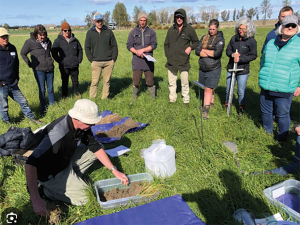
OPINION: Farmers, rural professionals and scientists were together last month in Hamilton, discussing hot topics for the land-based primary sector at the New Zealand Grassland Association (NZGA) conference.
“Fuelled by science and tempered by experience,” the information from NZGA is the foundation of many successful farming operations. Each year the attendees visit farms in the area and learn about the challenges and opportunities from people immersed in the issues. Exchange of information leads to more thinking, more discussion, and improvements – on the farm, in the field, glasshouse and laboratory.
It is the rigour of debate that enables progress. Researchers present their data to the audience and questions follow. Some will be points of clarification on the process of data gathering, others might be on interpretation of results. Sometimes an extra piece of information can be added leading to a eureka moment. Often more research will follow, perhaps including the person with the extra ideas. All parties benefit from the interaction, and so does the research process.
Conferences are the verbal equivalent of the refereeing process for written work. Research is critiqued to achieve improvement.
It is important to note that critique is not the same thing as criticism.
Critique is not personal and used to be part of the education process in research degrees.
Research proposals involve a written report on the hypothesis, rationale based on existing literature and the experimental approach. In doctoral research a presentation and interrogation follow. The idea is to have different people looking at the proposed research from different perspectives to check for logic, application and likelihood of success.
In the NZGA conferences, the most common question from farmers is “How will that benefit me on farm?”
They are right to ask.
Cuts in funding have pushed researchers into finding money wherever they can. The Ministry for Primary Industries (MPI) has facilitated farmerdirected research but that has not always had the outcome desired by the farmer.
A classic example is the research on the use of Brix meters in pastures presented at the conference. The paper can be found by putting the title (Brix was not a good indicator of pasture quality) into a search engine. The title rather gives the clue about the outcome of the research… The work was funded by MPI’s Sustainable Food and Fibre Futures fund (SFFF) and a heap of others. It was a great example of a group coming together, but the basic comment that Dr Doug Edmeades wrote in 2009 in Fertiliser Review stands – Brix is good for grapes and wine making. Yet the research was funded because some people (not necessarily the researchers) thought it was a good idea. Where was the independent challenge on whether investment was or wasn’t warranted?
More research funded by MPI’s SFFF was presented at the conference by Lincoln University. It was under the regenerative agriculture banner and has allowed the researchers involved to do some in depth and in detail work. Again, a search on ‘Sheep liveweight and dry matter production from Year 3 of the Regenerative Agriculture Dryland Experiment’ will find the paper. In brief, dry matter production was 1,550 kg/ ha (22%) greater on the regenerative plots than the conventional plots, but quality (protein and energy) was lower. The result was that sheep liveweight production was 131 kg/ha (23%) lower for regenerative than conventional plots. Another search, this time for AgScience 57, October 2020, will produce a lot of information to assist understanding.
Some investigations presented at the conference were funded by the NZ government, and the range of other funders (e.g. Northland Inc, AGMARDT, regional councils, seed and fertiliser companies) indicates that research is considered important in New Zealand, and is a team effort with everybody chipping in. But if everybody is involved, where does the rigour of debate that is stimulated by an independent perspective fit in?
Conferences retain an important role for thrashing out the issues. The old days of pistols at dawn have gone, and fisticuffs are frowned upon. There are now concerns about politically correct sensitivities that were not apparent in the old days when scientists were able to call a spade a spade. And dumb ideas stupid… But verbal exchanges can still be sparky.
And the antagonists are then seen in the bar together exchanging more words and ideas.
The goal is always progress.
Anybody who missed the Hamilton conference can check on the research on the Grasslands Journal website, but cannot catch up on the debate, discussion and general celebration of being with colleagues, friends and sparring partners. Also missing is the chance to have your say, put your oar in, ask the pointy questions and generally make a difference.
Next year’s conference is being held in Marlborough from 28-30 October. The organisers look forward to seeing you there; the researchers look forward to your challenging questions.
Dr Jacqueline Rowarth, Adjunct Professor Lincoln University, is a farmerelected director of DairyNZ and Ravensdown. She is also a member of the Scientific Council of the World Farmers’ Organisation and Chair of the New Zealand Grassland Trust. This email address is being protected from spambots. You need JavaScript enabled to view it.