
Boots Off, Brains Unplugged
OPINION: Across the country, farmers are juggling stock, pasture, animal health, fertiliser, contractors, staff, weather, cash flow and an endless list of jobs that cannot wait.




 increase font size
 BOP Ballance Environmental Farm Award winners Mark and Catriona White.
Kiwifruit growers Mark and Catriona White and their Coastal Kiwis orchard have won the Bay of Plenty Ballance Farm Environment Awards.
Ten years ago the Whites set out to find a better lifestyle for their family away from the city; they found it on a bare block near Opotiki.
Their work and passion have transformed part of an organic dairy farm into the successful 5.85ha orchard it is today, the awards judges said.
“The concept of kaitiaki – acting as a guardian, protector and conserver – is evident in all aspects of the Coastal Kiwis orchard business.”
The judges said the Whites did not compromise: being organic was not a barrier to excellent productivity in the orchard.
“Organics is a licence to do things differently. Every opportunity is taken to try to learn new things by observation and open mindedness.”
Catriona’s parents had offered the couple the chance to buy part of their organic dairy farm near Opotiki to develop as a kiwifruit orchard.
“My family has been farming this land four generations and our children (Letisha, 14, and Lochlan, 13) are the fifth generation to live here. For most of that time the land has been farmed using organic principles,” Catriona says.
Although they initially didn’t know much about kiwifruit, they did most of the physical development work themselves, keeping costs down and learning by their mistakes. Mark also did a National Certificate in Horticulture.
The orchard had 3.19ha of Zespri Organic Green kiwifruit, producing a total of 23,483 trays of kiwi-start fruit in 2017. Zespri Organic SunGold (G3) is now grown on 2.65ha producing 38,362 trays -- this in a “challenging growing year” with cyclones and a wet, windy autumn.
Recently developed blocks of SunGold are set to produce in the next season. Initially the Whites grafted Hayward Green and Hort16A gold kiwifruit onto Bruno rootstock. They decided to remove the gold vines when they saw the devastation caused by the vine disease Psa-V. Organic passionfruit produced income until the newly grafted G3 vines began producing.
A small flock of certified organic sheep eat the weeds on the edges of the orchard, helping reduce tractor work and its soil compaction, especially in winter.
Organic sprays are used as required to disrupt pest life-cycles. And unpaid ‘pest experts’ work in the orchard: weka and fantails prey on insects, bird seed plants are grown to encourage birds away from eating kiwifruit flower buds, and slugs help to recycle organic material on the floor of the orchard.
“With plenty for the slugs to eat on the ground, they don’t bother to chew on the newly grafted vines. It’s a matter of finding the point at which everything can live in balance,” Mark says.
He is active in the Tablelands Irrigation Scheme. Water use is carefully planned and monitored.
The Whites were presented with the Bay of Plenty regional supreme award at a dinner on February 23 at the ASB Baypark Arena, Mt Maunganui. They also won the Bay of Plenty Regional Council Award, Zespri Kiwifruit Orchard Award and the WaterForce Integrated Management Award.
Other winners at the dinner included Barbara and Wilson McGillivray, Awatea Orchard, Katikati, who won the Ballance Agri-Nutrients Soil Management Award and the Predator Free Farm Award. Whakatane sheep and beef farmers David and Carol Hodge won the Treeline Native Nursery Farm Stewardship Award, the Beef + Lamb New Zealand Livestock Award and Bay of Plenty Regional Council Environmental Award.
About the awards
The Ballance Farm Environment Awards recognises and celebrates good farm practices which promotes sustainable land management through an annual awards programme which is now run in 11 regions throughout New Zealand. More information about the awards is also available on www.bfea.org.nz
OPINION: Across the country, farmers are juggling stock, pasture, animal health, fertiliser, contractors, staff, weather, cash flow and an endless list of jobs that cannot wait.

Zespri has welcomed the entry into force of the India-New Zealand Free Trade Agreement today, calling it a significant milestone that will support long-term growth in one of the world’s largest and fastest-growing consumer markets.
Farmer-owned fertiliser company, Ballance Agri Nutrients is welcoming National’s plan to negotiate security agreements with key supplier countries to protect New Zealand-bound products from export restrictions and greater supply chain certainty.
Where any worker in the kiwifruit industry is mistreated, we expect the authorities to take action.
Kiwifruit growers are watchful but remain optimistic as concerns around the potential effects of the El Niño weather pattern this season.



Three men have been sentenced in District Courts after Ministry for Primary Industries prosecutions over animal welfare, food safety and cattle tracing offences.
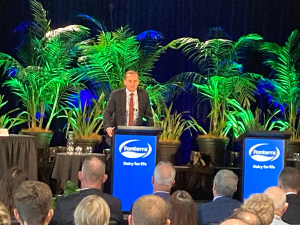
Fonterra’s 2026 financial year was a year of delivery, with record volumes of milk collected, processed and shipped by the co-op.
OPINION: The Government's decision to reinstate agriculture and horticultural science as a standalone subject from Year 11 is the right one.
Dairy farmers, still holding onto their Fonterra shares despite switching milk supply elsewhere or exiting the industry, now face a stricter share sell-down requirement.
Hamilton-based agritech company Aimer Farming has completed a $3 million capital raise to support its next stage of growth, including a beef farming product due to launch in 2027.
When dairy manager Miriam Lauridsen learned the farm, she was joining held weekly health and safety meetings, she initially thought that was “a bit over the top”. Experiencing that culture changed her mind.





OPINION: The same mainstream media muppets that brought you Jacindamania in 2017 have been flat out pimping for the Opportunities…
OPINION: Your old mate reckons the atrocious way farmers in the UK are treated by their lords and masters in…




