Krone Group Earnings Drop Despite Stable Farm Machinery Sales
While turnover was back slightly at €2.3 billion in 2024/2025 (previous year €2.4 billion), the German Krone Group saw earnings fall from €107 million to €40.1 million.
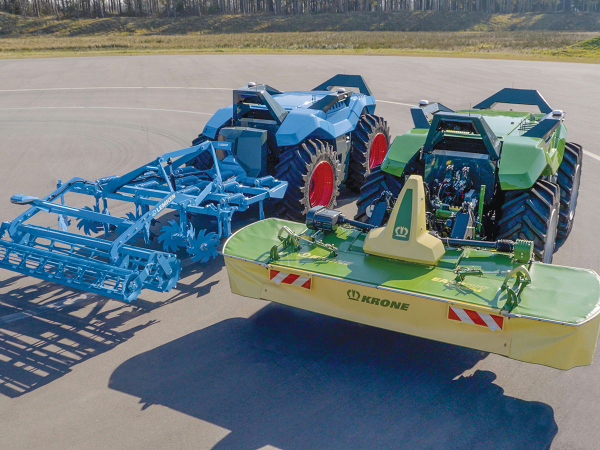
German machinery manufacturers Krone and Lemken recently revealed a new collaborative concept they have been exploring centering around a 230hp diesel-electric autonomous tractor.
German machinery companies Krone and Lemken are probably better known for their grassland and cultivation products.
However, the pair recently revealed a new collaborative concept they have been exploring. The Combined Powers project centres around a 230hp diesel-electric autonomous tractor that sees electricity, produced by the drive unit, transferred to the wheels, PTO and hydraulic systems.
The machine is said to have been developed to address the increasing problem of finding skilled labour. Both companies believe it will also free farmers from spending extended hours in the paddock undertaking harvest, cultivation and planting.
Tested in secret during 2021, no doubt helped by the ongoing Covid pandemic creating lockdowns and removing “prying” eyes, the concept was tested with a wide range of implements – including ploughs, cultivators and drills, as well as mowers tedders and swathers.
In practise, what were tractor drivers will now become machine operators – controlling the unit from a mobile device. This will involve transmitting jobs and receiving completed job reports via a communications module and Agri-Router – an already established data exchange hub.
In the paddock, sensors mounted on the drive unit will monitor the immediate surroundings and the implement – with the former being controlled by the latter. This, the companies explain, is important to achieve consistent and accurate work.
Based on experience with ISOBUS and TIM on existing Krone and Lemken products, the drive unit and implements communicate and interact sharing all types of data.
Livestock Improvement Corporation (LIC) and the Ag Emissions Centre have completed the latest phase of a mult-year methane research project, providing important insight into the role genetics may play in reducing gross emissions.
A lavish signing ceremony in Delhi has cemented in place a deal that will have massive economic benefits for some of NZ's key primary exports - notably forestry, horticulture, sheepmeat and wool.
Rapid growth in dairy farm worker pay in recent years means more money in the pockets of New Zealanders, says Federated Farmers dairy chair Karl Dean.
New Zealand exports to the European Union have surged by $3 billion in two years under the New Zealand-European Union Free Trade Agreement.
A new joint investment of $1.2 million aims to accelerate farmer uptake of low-methane sheep genetics, one of the few emissions reduction tools available to New Zealand farmers.
The Food and Agriculture Organization of the United Nations (FAO) has issued a stark warning about the global implications of the ongoing Gulf crisis.

OPINION: When Donald Trump returned to the White House, many people with half a brain could see the results for…
OPINION: Media trust has tanked because of what media's more woke members do and say.