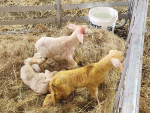
Beef + Lamb NZ's Lambing Kit Checklist for a Tough Season
With lambing underway in many regions, Beef + Lamb New Zealand is encouraging farmers to put together a wellequipped lambing kit to help minimise lamb losses, particularly in bad weather.




 increase font size
 A versatile and stylish South Island selection on offer this week saw most types well supported, despite a slightly firmer NZ dollar.
A versatile and stylish South Island selection on offer this week saw most types well supported, despite a slightly firmer NZ dollar, says NZ Wool Services International's chief executive John Dawson.
Compared to the last sale on November 26 the indicator for the main trading currencies was up 1.05% only having minimal impact in some quarters.
Dawson advises that compared to the last time sold on November 19, merino fleece 20.5 microns and finer were firm to 1.5% easier with 21 to 23.5 microns 1 to 3% dearer.
Mid micron fleece 24 to 29.5 microns were 1% dearer.
Compared to the sale on November 26;
Fine crossbred full fleece 32 and 33 microns were up to 5% cheaper with 34 and 35 microns 1% dearer. Fine crossbred shears were firm to 2.5% cheaper.
Coarse crossbred full fleece 36 microns and coarser were firm to 1% firmer.
All shear types remained firm.
Good colour short oddments were firm to 3% dearer.
There was well spread interest with China and Australasia dominating, supported by Western Europe, Middle East, United Kingdom and India sparingly.
The next sale on December 10 comprises about 9,200 bales in the North Island, including the wools from this week's cancelled sale.
With lambing underway in many regions, Beef + Lamb New Zealand is encouraging farmers to put together a wellequipped lambing kit to help minimise lamb losses, particularly in bad weather.

New Zealand wool is reaching new heights as air filtration companies move away from synthetic products to biodegradable alternatives.
Will a stronger, more coordinated voice help rebuild confidence and improve returns in the wool sector?
OPINION: Confidence in the wool sector is rebounding as prices hit levels not seen in more than 15 years.
Rising strong wool prices are finally returning the sector to profitability.



Federated Farmers has welcomed new rural policies released by ACT, saying they align closely with its own election priorities.

Rural Contractors NZ says proposed changes to land transport rules for agricultural vehicles are a welcome response by the Government to out of date regulations which have seen members hit with huge fines.
Alliance is calling for final applications for its 2027 Graduate Programme, with applications closing on Sunday 25 October.
Decades piloting planes has ensured vet and farmer David Hayes is focused on safety. So, after a serious accident while welding on farm, he is sharing his experience so others can learn from it.
Canterbury milk processor, Synlait Milk has confirmed Leon Fung as its chief executive officer.
OPINION: Making it easier to collect rainwater and use it to grow crops and livestock is a no brainer.





OPINION: The same mainstream media muppets that brought you Jacindamania in 2017 have been flat out pimping for the Opportunities…
OPINION: Your old mate reckons the atrocious way farmers in the UK are treated by their lords and masters in…




