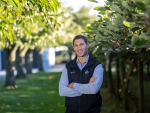
For the second time in two seasons, Owen St George’s kiwifruit orchard has posted a top orchard gate return (OGR) for its green variety with post-harvest company DMS.
This year, despite producing less fruit than the previous season, the Te Puna orchard saw an increased OGR of $99,000 based on 11,760 trays per hectare, thanks to an outstanding $3.37 per tray Kiwistart payout. Last year’s 15,109 trays per hectare produced an OGR of $90,000, after having been stored throughout the season.
Owen says the two top consecutive results – albeit on opposite sides of the scale – are all about income consistency.
“It’s all about being consistent with what you’re doing and producing good results every year.”
He says the 2014 season’s result came down to a smaller crop, which still produced size 31 fruit, with high TZG (Taste Zespri Grade) despite picking early.
“In the 2013 season we had a huge crop and picked late in May. Last season it was completely different and we picked incredibly early. There’s two ways to skin a cat and that’s exactly what happened.
“There’s always huge potential if you can time it right with Kiwistart and that’s what we did – we hit ISO week 13. It was luck. Of course it also helped that we had big fruit, a low reject rate and very good taste which saw us in Y-band.”
Luck was also on the orchard’s side earlier in the season, when there were initial issues with high caning. The day the bud burst spray was applied was not ideal. However, Owen says in hindsight it was “the best thing that could have happened”.
Matt Greenbank of DMS manages the orchard and Owen says that having a good manager is a key ingredient.
“Matt knows exactly what to do and when to do it. The two most important things are pollination and winter pruning, so we always focus heavily on them. Making sure the fruit has enough light is another key.”
Owen believes the green variety will remain the backbone of the industry, particularly after Zespri’s next two to three year forecast of solid returns.
“Green is such a good fruit and is popular around the world. It’s the backbone of the industry and always will be.”
Owen purchased the orchard, which includes 2.66ha of green and 1.3ha of converted Gold3, around 10 years ago after 34 years of farming.
The orchard has been through some significant changes since then, including grafting new chieftain males around six years ago. Every second row is now male.
“We are now seeing the benefits of that hard work paying off.”
With this coming season’s results still up in the air, including the orchard’s first crop of G3; Owen is pragmatic about kiwifruit being a long game.
"It all comes back to consistency," he says.