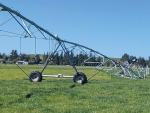
Australian teams to help repair North Canterbury irrigators after storm
Moves are afoot to get a team of Australians over here to help repair North Canterbury's irrigation machinery, ravaged by the big windstorm of late October.




 increase font size
 Electricity Networks Aotearoa (ENA) chief executive Tracey Kai.
Power bills could be lower, and power restored faster following a storm if landowners took greater responsibility for trimming trees - so they don't come down on transmission lines.
This from Tracey Kai, the chief executive of Electricity Networks Aotearoa (ENA), which represents the 29 companies who are responsible for maintaining power poles and power lines throughout the country. She says it's estimated that between 85% and 95% of the outages in the recent storms in Southland and Otago were caused by trees bringing down power poles and lines.
She says as well as bringing down power poles and lines, trees cause the additional problem of blocking road and track access to damaged power infrastructure on both public and private land.
"All of this means the recovery operation takes much longer than would otherwise be the case," she told Rural News.
Kai says when people plant trees, they don't always think of their surrounds and whether power lines could be affected at some stage in the future.
She says lines companies of EDBs (electricity distribution businesses) constantly monitor potential tree problems and in many cases do the necessary trimming themselves.
"Last year, they spent $67 million doing this work - the cost of which is passed on to the consumer. If they didn't have to do this, power bills would potential be lower," she says.
Kai says if the EDBs see a problem on a property, they can notify the owner to fix it themselves, but she says in most cases the companies will do the first trim themselves and try and put the onus on the landowner to fix the problem if it occurs again.
"But many of the EDBs just do the work anyway, figuring that it is cheaper in the long run to trim or cut down a tree rather than waiting for a storm for the tree to come down and cause a power outage," she says.
There are rules already in place around where the responsibility lies for the maintenance of trees near power lines and more stringent ones are in the pipeline, but are unlikely to come into force until 2027/28. So there will likely be more storms before the new rules kick in.
Kai says the EDBs do what they do because it's right thing and for the most part landowners cooperate.
But she says they had an instance before the floods in Motueka where the local power company identified a problem with a tree on a farm, but the owner refused to let them fix the problem at no cost.
She says, come the floods, the tree came down and it took out the power to a community for several hours.
"We have sympathy to what I call the 'mums and dads' who have a tree problem but don't have the financial resources or the skills to deal with it. We will always help them," she says.
However, Kai says those who are planting trees for commercial purposes - making a profit from trees - should have to pay for any damage to the lines and infrastructure on their properties.
She says some landowners don't like power lines going through their properties, but the electricity network cannot go around corners to avoid a farm or forestry block.
"The reality is that people only recognise the problems with trees and power lines when there is an outage and the recent storms in the deep south has certainly brought this issue to the fore," she says.
Moves are afoot to get a team of Australians over here to help repair North Canterbury's irrigation machinery, ravaged by the big windstorm of late October.

The raising of six heavy power cables across the Waikato River last week was a milestone in lines company Unison’s work to energise 30 new dairy farms in the Taupo region.
FEDERATED FARMERS is helping farmers understand their rights when it comes to electricity lines on their property.
Dairy farms could reduce electricity use by about 10% - the equivalent of power use by about 7100 households, a pilot programme has shown.
Federated Farmers is opposing the Western Bay of Plenty District Council's moves to create buffer zones of up to 32m either side of electricity transmission lines.



The potato industry is celebrating the success of two rising stars - James Blair, the 2026 Young Grower of the Year and runner-up and innovation award winner, Amber Davy.
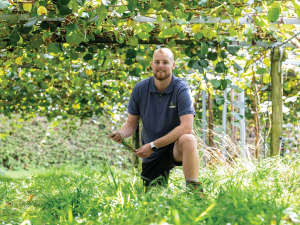
Twenty-eight emerging leaders from across the horticulture sector spent two days last month learning valuable skills and connecting with industry experts.
There are five entrants in this year’s Young Horticulturist of the Year, competing in a series of technical, practical, business and leadership challenges.
A seasoned horticulturist has been appointed to deliver the Apple Action Plan, a key initiative of the India-New Zealand Free Trade Agreement.
New Zealand's citrus growers have been told to compete on the value built into their fruit rather than the volume they grow.
Hawke's Bay fruit growers are being reminded of the need to prepare for whatever the El Niño weather system may bring in the coming months.





OPINION: The same mainstream media muppets that brought you Jacindamania in 2017 have been flat out pimping for the Opportunities…
OPINION: Your old mate reckons the atrocious way farmers in the UK are treated by their lords and masters in…




