Damien O’Connor Criticises Budget 2026 as ‘Miserable’ for Rural New Zealand
A miserable budget that didn’t deliver much for anyone.




 increase font size
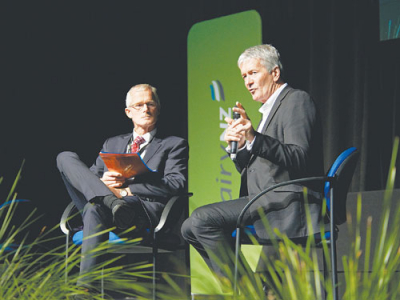 Agriculture Minister Damien O’Connor and DairyNZ chairman Jim van der Poel address last week’s DairyNZ Farmers’ Forum in Hamilton.
Politicians are rubbishing reports that the dairy industry will need to reduce cow numbers to improve fresh water quality.
Agriculture Minister Damien O’Connor says media reports “misinterpreted” what Environment Minister David Parker said recently on television.
“The media have an agenda; the National Party has an agenda,” he told Rural News.
O’Connor says Parker was talking about nutrient budgets and farmers understand that.
“The question is how we get on to improve nutrient management. There are no plans on cow numbers at all; in fact we said that to Greenpeace who were thinking about a moratorium [on cow numbers] that we don’t buy into.
“We leave it and we can trust the farmers as long as they get clear signals and know what the targets are. I think they will get on with it; we’ve said the target is swimmable water at least.”
O’Connor used his speech at the DairyNZ Farmers Forum in Hamilton last week to allay fears of farmers being forced to reduce cow numbers.
“If you’re on the National Party email list you are probably told it’s cow numbers; that’s not the truth.”
Climate Change Minister James Shaw, who also spoke at the Farmers Forum, told Rural News that media reports on cow numbers were “fear mongering”.
“We are talking about nutrient budget catchment by catchment; that’s exactly what has been happening -- simply taking the best practice and applying it to the whole country.”
DairyNZ chairman Jim van der Poel says DairyNZ in principle supports nutrient budgets.
“They have been around for a while; we agree on managing nutrients on a catchment-by-catchment basis, and that it’s important all farmers and communities – not just dairy farmers – work in a sustainable way.
“Achieving clean waterways is a responsibility for all New Zealanders and we are and will play our part.
“Dairy farmers are very often part of the solution and often leading the work in catchments. We are working closely with the Government and David Parker on this issue and although media interpreted this as being about cow numbers, we don’t believe that is the case.”
Van der Poel says it’s important to protect rural communities as they adjust to new farming practices, given that “thriving rural communities are important to this Government as well”.
A miserable budget that didn’t deliver much for anyone.

National's decision to ‘dribble’ information about the NZ/India to Labour contributed to the delay in it deciding to supported the FTA.
When it comes to international trade, politicians from all sides of the aisle are united, says Labour's trade spokesman Damien O'Connor.
Federated Farmers have reiterated their support for the coalition Government to abolish the present ban on the live export of animals.
As the coalition Government mulls new regulations to reinstate the export of live animals, debate is heating up between supporters and opponents.


Farmgate lamb prices are down by 8%, beef cattle by 4.5% and farm expenditure up by 4.2%.
Kiwifruit growers are watchful but remain optimistic as concerns around the potential effects of the El Niño weather pattern this season.
Almond hulls sourced from Australian orchards may have the potential to help New Zealand cows reduce emissions, boost milk yield and lower input costs.
Striking a balance between meeting the needs of industry to speed up approval time for products but on the other hand ensuring that risks are properly assessed.
Surprised, humbled and quite thrilled. That’s the reaction of James Allen, one of the founding partners and now chief executive of AgFirst, on being made a life member of the Institute of Rural Professionals.

OPINION: The same mainstream media muppets that brought you Jacindamania in 2017 have been flat out pimping for the Opportunities…
OPINION: Your old mate reckons the atrocious way farmers in the UK are treated by their lords and masters in…