
Farmlands Shareholders Challenge AgriZeroNZ Investment
Farmers opposing rural trader Farmlands’ investment in AgriZeroNZ are warning the co-operative board not to brush away their concerns.




 increase font size
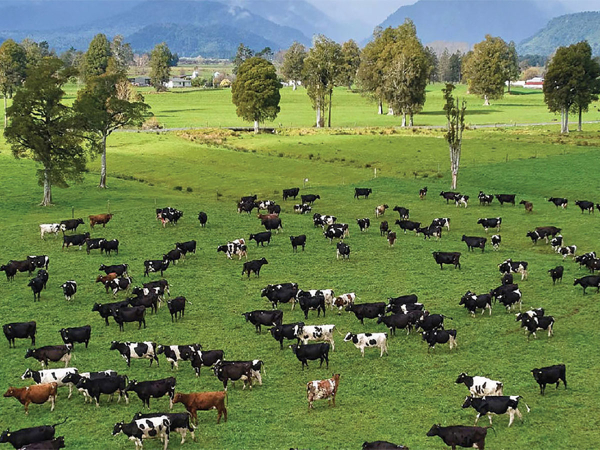 Can New Zealand test and embrace technologies that increase farm earnings while also reducing environmental losses?
With some farmers opposing a government-industry partnership set up to develop methane reducing products, one NZ company claims that it already has a product on the market.
Biozest claims it can increase productivity and reduce emissions so that methane reduction is not a cost to the farmer. Its outcomes include 24–40% reductions in urinary urea, 89–127% increases in pasture productivity, and 30% increases in livestock production.
Commercial and farm-modelled outcomes include a 30% improvement in sheep and beef productivity, approximately $650/ha, a 22% increase in stud bull finishing weight gain over 68 days, approximately $1,645/ha, and a 33% increase in dairy goat milk solids production, achieved without additional water, fertiliser or other inputs.
But company founder and scientist Nathan Balasingham says that while it accepts responsibility for substantiating Biozest’s claims, it needs funding support.
“The full emissions trial being asked of us is estimated to cost $5–6 million upfront,” he told Rural News.
“We cannot fund it, and we do not believe it is the right first step before the evidence gaps and recognition requirements are agreed.”
The predicament is both methodological and financial, he adds.
“Our concern is that, where additional production is interpreted as additional feed intake without recognising improved feed conversion, a model may calculate higher emissions and miss genuine efficiency gains. This needs independent testing.”
Balasingham says their evidence includes controlled trials, peer-reviewed findings on pasture composition and urinary urea, and production records.
“We are willing to provide that evidence and support further evaluation. We are not asking someone else to prove the product works.
“However, we cannot undertake the required full emissions programme ourselves.”
He is proposing a staged, independently led pathway.
First, he recommends a review of the existing evidence and agreeing the acceptance requirements with the Ministry for Primary Industries.
Then undertake targeted, controlled farm evaluations with participating farmers to resolve the critical intake, output, methane and nitrogen questions; and expand to a full emissions programme where the findings justify it.
Zest Biotech would contribute its data, product knowledge and support, while independent researchers control the emissions assessment, he says.
Balasingham believes New Zealand can establish a proportionate, credible pathway to test and recognise technologies that increase farm earnings while also reducing environmental losses.
“Rather than make a $5–6 million upfront trial the entry barrier, we are asking for rigorous scrutiny and a workable route to recognition, not a waiver of proof,” he says. “Meanwhile, farmers continue to use Biozest because it increases pasture and livestock productivity and makes pasture more resilient to weather stress, but our aim is that they will also be rewarded for reducing emissions.”
Government-industry partnership AgriZero has so far raised over $300 million from major agribusinesses and the government.
The money is used to fund the development of tools to mitigate methane emissions.
AgriZero hopes to have tools available for farmers by 2030.
Farmers opposing rural trader Farmlands’ investment in AgriZeroNZ are warning the co-operative board not to brush away their concerns.

Wayne McNee, chief executive of AgriZeroNZ, has resigned and will leave the organisation on 15 January 2027.
With New Zealand’s greenhouse gas emissions in the spotlight, Auckland scientist Nathan Balasingham says there’s a better way to tackle the problem than shrinking cow numbers or fertiliser usage.
Farmer lobby Groundswell believes that farmers are worried about the implications of a potential centre-left government.
AgriZeroNZ has invested a further NZ$17.7 million in methane vaccine developer ArkeaBio and NZ$5.1 million in BioLumic, a New Zealand-founded company that uses ultraviolet light to develop low-emissions pasture..

With some farmers opposing a government-industry partnership set up to develop methane reducing products, one NZ company claims that it already has a product on the market.

During the nesting season, from September to December, industrious starlings can quickly build nests in the darker areas behind tractor and vehicle, usually close to hot engines, typically resulting in localised damage or in some cases complete write-offs.
The meat processing industry is much more collegial than it was in the past and is now more focused on common goals.
With the last couple of months having seen some potential tractor purchases put on hold with the impending election and continued input cost rises, year-to-date figures, ending September, has seen deliveries up around 5% over the same period in 2025, with a total of 2026 units.
Beef+Lamb New Zealand is calling for nominations for director roles in the Northern South Island and Northern North Island electoral districts.
Fonterra chief executive, Richard Allen says being resilient has helped the dairy industry overcome extreme volatility in recent years.




OPINION: The same mainstream media muppets that brought you Jacindamania in 2017 have been flat out pimping for the Opportunities…
OPINION: Your old mate reckons the atrocious way farmers in the UK are treated by their lords and masters in…




