
Agri sector to lead economic recovery
OPINION: Over the past month, people up and down the country have been asking me what I think is in store for the Agri sector.




 increase font size
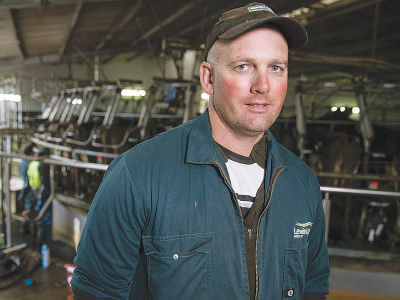 Federated Farmers dairy chairman Chris Lewis.
Farmers are urging banks to take a long term view of their businesses, now under growing pressure to improve their balance sheets.
Federated Farmers dairy chairman Chris Lewis says some farmers feel they are facing “a banking crisis” because of relentless pressure from banks.
While ultimately farmers must ‘own’ their individual financial positions, Lewis says banks need to go easy.
“They must take the long term view that dairying is a profitable business,” he told Rural News.
He says farmers have contacted him to complain about bank tactics. “There’s no doubt that farmers are under increasing pressure from the banks,” he said.
A Putaruru farmer, preferring to remain anonymous for fear of reprisal by his bank, contacted Rural News to complain about its high-handedness.
“I’ve never been spoken to like that in my life,” he said referring to a meeting he recently had with his ANZ bank manager.
He says rumours are rife that some banks are devaluing land by 25%, leading to higher debt to equity ratio for farmers.
His Putaruru farm, whose value was at least $5 million five years ago, would now fetch no more than $4m, giving the bank an opening to devalue his farm to $4m.
“With my debt around $3 million, the bank is forcing me out of farming, my livelihood,” he said.
ANZ general manager agri, Troy Sutherland, says the bank has been encouraging dairy customers to repay debt and improve their balance sheets to enable them to deal with challenges facing the sector.
“Currently, the agri sector is in good shape, but there are challenges ahead, such as increased regulatory demands, regional economic cycles and more stringent environmental practices,” he told Rural News.
“In our experience farmers are not afraid to lean into some of these challenges. But confidence is lacking in their uncertainty about what ‘good’ looks like and what their pathway is for getting there.”
Sutherland says the bank has seen some land values slip over the past few years, but he denies a 25% drop in value.
“Our own tracking of the market has seen a slight decrease of land values over the past two years, but sales evidence has been very low.”
However, Lewis believes the situation is dire for farmers in Southland where they don’t have the choice of selling land to other sectors like horticulture, as farmers have in Waikato.
“In Waikato land values are holding up because they are being converted into horticulture blocks, housing development and even chicken sheds. In Southland, where they can’t diversify, any drop in land value will hurt farmers.”
Milk price volatility, including swings in global dairy prices, is also adding to uncertainty in the dairy sector.
Ironically, it seems Westland Milk suppliers are among the best placed since the August 1 takeover by Chinese company Yili.
Lewis says one Westland farmer contacted him to say they were getting a $5.70/kgMS advance rate from Yili as per their sale agreement. Yili is matching Fonterra’s payout for 10 years and paying 85% of that as the advanced rate.
Fonterra has an opening payout range of $6.25 to $7.25/kgMS, paying an advance rate of $3.80/kgMS to its farmer suppliers.
OPINION: Over the past month, people up and down the country have been asking me what I think is in store for the Agri sector.

OPINION: Despite the volatility created by the shoot-from-the-hip trade tariff 'stratefy' being deployed by the new state tenants in the White House, farm commodity prices are holding their own.
OPINION: Clicking through some news of late, I have noted the odd headline referring to credit card debt.
Food and vegetable grower and marketer T&G Global has trimmed its half-year losses compared to last year, as it makes progress delivering its strategy and continues to recover from the impact of Cyclone Gabrielle.
Rabobank released its Agribusiness Monthly for March. Here's what the bank had to say about the dairy sector, farm input prices and the weather.


Dairy processors are ready to further boost New Zealand’s export earnings but want the incoming government to match their ambition with good policy.

Massey University is best placed to solve the “problems” facing the dairy industry, says vice chancellor, Pierre Venter.
Synlait's longest serving employee – a man who joined the Canterbury-based milk processor even before it began processing milk – is now its newest executive.
A dairy industry leader believes eradicating the common and costly disease, Bovine Viral Diarrhoea (BVD) is within reach.
A farmgate milk price of $10/kgMS this season is firming up as milk powder prices soar and the New Zealand dollar weakens.
Federated Farmers has welcomed new rural policies released by ACT, saying they align closely with its own election priorities.





OPINION: The same mainstream media muppets that brought you Jacindamania in 2017 have been flat out pimping for the Opportunities…
OPINION: Your old mate reckons the atrocious way farmers in the UK are treated by their lords and masters in…




