
Resilient Global Dairy Industry Overcoming Volatility
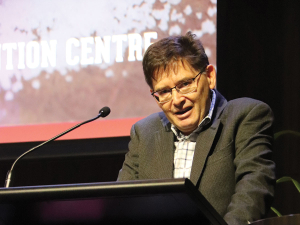
Fonterra chief executive, Richard Allen says being resilient has helped the dairy industry overcome extreme volatility in recent years.




 increase font size
 Kerr told police royalties totalled $100,000 a year on Feratox and the Crown asserts he stood to gain financially if 1080 was banned.
The man who threatened to put 1080 into infant formula has been named as Jeremy Hamish Kerr, 60, of Auckland.
He was creator of a pest-control product and 1080 alternative Feratox. He pleaded guilty in December to two counts of blackmail. Threats were sent to Federated Farmers and Fonterra in November 2014 threatening to poison infant formula if New Zealand did not stop using 1080 by the end of March 2015.
The Crown asserts he was motivated by financial gain, which he denied at a disputed facts hearing started last week in the High Court at Auckland to give the judge greater clarity around his motives. The hearing was the first time his identity was made public.
Kerr claimed he was suffering from poor mental health and "cracked". He said he was triggered by media reports on 1080 and comments by Environment Minister Nick Smith.
Kerr told police royalties totalled $100,000 a year on Feratox and the Crown asserts he stood to gain financially if 1080 was banned. The hearing was adjourned until next month. Kerr could face 14 years behind bars.
Two companies dealing in pest control products, Connovation Ltd and Connovation Research Ltd, issued statements emphasising their companies are not connected to those companies operated by Jeremy Kerr.
Infant Nutrition Council chief executive Jan Carey says it was a highly despicable thing to do.
However, she believes that any smaller infant formula businesses going out of business would be more to do with the Chinese changing to regulations to make it more difficult for contract manufacturing than the 1080 scare.
"The Chinese want supply integrity, they want an integrated system. With the small companies that have gone out of business it is much more likely to be because of the changes in Chinese regulations... than the 1080 threat."
She can't say speak for individual businesses that may have been affected by the 1080 threat, but she does know that brand companies without manufacturing facilities are having trouble surviving.
Fonterra chief executive, Richard Allen says being resilient has helped the dairy industry overcome extreme volatility in recent years.

Northland farmer Greg Collins has taken over as chair of the Fonterra Co-operative Council.
Farmers will wait it out like the rest of the country as the composition of the incoming government remains up in the air.
Fonterra’s 2026 financial year was a year of delivery, with record volumes of milk collected, processed and shipped by the co-op.
Dairy farmers, still holding onto their Fonterra shares despite switching milk supply elsewhere or exiting the industry, now face a stricter share sell-down requirement.



During the nesting season, from September to December, industrious starlings can quickly build nests in the darker areas behind tractor and vehicle, usually close to hot engines, typically resulting in localised damage or in some cases complete write-offs.
The meat processing industry is much more collegial than it was in the past and is now more focused on common goals.
With the last couple of months having seen some potential tractor purchases put on hold with the impending election and continued input cost rises, year-to-date figures, ending September, has seen deliveries up around 5% over the same period in 2025, with a total of 2026 units.
Beef+Lamb New Zealand is calling for nominations for director roles in the Northern South Island and Northern North Island electoral districts.
Fonterra chief executive, Richard Allen says being resilient has helped the dairy industry overcome extreme volatility in recent years.
The head of the Ministry for Primary Industries (MPI) trade and international relations group says New Zealand is well-positioned to secure trade access and compete internationally as the world becomes more complicated, demanding and uncertain.




OPINION: The same mainstream media muppets that brought you Jacindamania in 2017 have been flat out pimping for the Opportunities…
OPINION: Your old mate reckons the atrocious way farmers in the UK are treated by their lords and masters in…




