Diplomatic Incident
OPINION: Your old mate hears an international incident is threatening to blow up the long-standing Anzac alliance as Kiwis and Aussies argue over who wants new Australian resident and former NZ Prime Minister Jacinda Ardern.




 increase font size
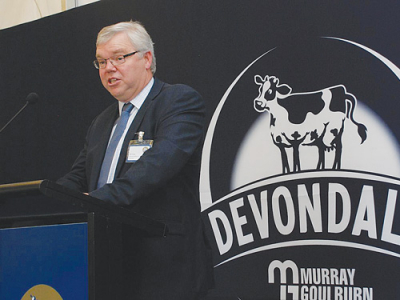 Murray Goulburn’s embattled chairman Philip Tracy is stepping down.
Embattled Australian dairy co-op Murray Goulburn says it is willing to work with other processors on a commodity milk price index.
The co-op is facing pressure from politicians and farmer shareholders for a more transparent milk pricing scheme after it was forced to claw back money paid in advance to suppliers.
The Federal Government says a commodity milk price index is the way forward.
Speaking at MG’s annual meeting last month, outgoing chairman Philip Tracy said the co-op will join other members of the dairy industry to explore ideas for improving Australia’s pricing transparency.
“This includes introducing the proposed commodity milk price index, which should be independently managed and tailored for the benefit of all participants.”
Milk price transparency has attracted intense interest from suppliers, government and other stakeholders this year.
Tracy says the MG board wants a review of the current annualised milk pool process to see if it is fit for purpose.
“This is particularly important given the co-op’s reliance on global markets, where we are seeing increased volatility.”
This volatility has resulted in two price step-downs in the past eight years against a total of three step-downs in the co-op’s 66 year history.
Tracy says as a co-op, MG’s objective is to maximise the farmgate milk price paid to suppliers; it typically announces a forecast full year final milk price and then pays 90-92% of the final price as the opening milk price. This supports supplier cashflows and responds to the intense competition for milk in the Australian market, which motivates processors to pay the highest possible opening price.
But this mechanism has proved problematic twice in the past eight years, he says.
“In New Zealand the opening price is traditionally a lower percentage, between 60-70%, of the forecast final farmgate milk price. This reduces the risk of a price reduction during the season. It also means NZ dairy farmers do not have the same level of cashflow at the start of the season.”
He says in Europe, the mechanism is different again: dairy farmers are quoted milk prices monthly. This more accurately reflects monthly market conditions but hinders farmers’ ability to forecast the financial year.
Each of these approaches has advantages and disadvantages, Tracy says. “So MG must take the opportunity to review the best approach, to ensure the business sends the right market signals, while also balancing farmers’ need for cash against what the market is paying.”
This review will require input from suppliers, Tracy says.
Quitting, sorry
The chairman of Australia’s largest milk processor is stepping down.
Murray Goulburn chairman Philip Tracy says he will remain chairman “for as long as is required to effect an orderly transition to a new chairperson”.
Speaking at MG’s annual meeting last month, Tracy again apologised for the financial crisis facing farmer shareholders.
“I want to again express how deeply sorry I am that MG suppliers have had to endure such a heavy burden.
“As your chairman, I am responsible for the stewardship of MG and therefore ultimately accountable for its performance. While as a board we did what we could with the information we had at the time, we know the outcomes of that period have been devastating for suppliers and for that we are deeply sorry.”
OPINION: Your old mate hears an international incident is threatening to blow up the long-standing Anzac alliance as Kiwis and Aussies argue over who wants new Australian resident and former NZ Prime Minister Jacinda Ardern.

OPINION: Your old mate hears that at a recent China Business Summit, PM Christopher Luxon delivered a none-too-subtle "could try harder" report card on the red meat industry regarding its exports to China - particularly when compared to Australia.
More Australian states are embracing virtual fencing technology, opening growth opportunities for Kiwi companies like Halter.
Fonterra says its ongoing legal battle with Australian processor Bega Cheese won’t change its divestment plans.
Farmers in the Australian state of New South Wales will soon be able to use virtual fencing and herding technology to boost farm productivity.


Farmer-owned fertiliser company, Ballance Agri Nutrients is welcoming National’s plan to negotiate security agreements with key supplier countries to protect New Zealand-bound products from export restrictions and greater supply chain certainty.

Carrfields has announced the appointment of Stu Hall to the newly created role of chief operating officer, Carrfields Ltd, reflecting the continued growth of their agribusinesses and the need to ensure the company has the leadership capacity and support in place as it pursues the emerging opportunities ahead.
New Zealand's role is not to compete with Indian growers, according to NZ Apples and Pears.
The potato industry is celebrating the success of two rising stars - James Blair, the 2026 Young Grower of the Year and runner-up and innovation award winner, Amber Davy.
Twenty-eight emerging leaders from across the horticulture sector spent two days last month learning valuable skills and connecting with industry experts.
There are five entrants in this year’s Young Horticulturist of the Year, competing in a series of technical, practical, business and leadership challenges.
OPINION: It seems Canterbury processor Synlait is still in the doldrums.
OPINION: Get offside with New Zealand First leader Winston Peters at your own peril.