Boosting Crop Production by Spreading Effluent
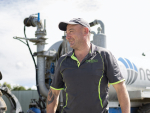
Tararua district farmer Jamie Harris milks around 400 cows using a split calving system on his farm, Crossdale Dairies.




 increase font size
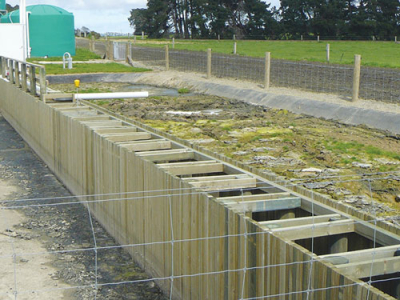 Weeping wall constructed for a 800-cow farm.
The Clean Green Effluent Company says its multi-award winning system leads the way in effluent technology.
This simple but effective automated distribution system has a minimal footprint and needs no large ponds, it says.
The system starts with a patented Weeping Wall encased in a concrete lined bunker; the Weeping Wall removes the solids and allows the liquid to flow into a pump chamber.
Green water is then stored for recycling. Outside yards can then be automatically cleaned using floodwash or backing gate nozzles, effectively cleaning the yards without the use of fresh water; this reduces the water take from the typical 50-70L/cow to 20-25L/cow.
Reducing water consumption has a two-fold effect, the company says. “Firstly, it reduces the cost of freshwater extraction and filtration; secondly, it reduces the amount of effluent to be dispersed to land.”
The Clean Green system allows liquid to be dispersed over large areas at the low rate of 0.25mm application depth. Effluent can be dispersed safely most days of the year.
“As we can disperse effluent year-round at low application depths, there is no nitrogen leaching and the pasture retains all nutrients provided, thus increasing pasture growth by up to 35%.”
No large ponds are required due to the 0.25mm application depth, so storage requirement is minimal.
The company says its system requires as little as two 30,000L water tanks to provide storage for greenwash and effluent dispersed.
“The advantage of the water tanks is they are guaranteed not to leak and have no rainwater catchment. Rainwater catchment in large ponds equates to doubling the amount of effluent being stored and having to be dispersed by pump to land.
The Weeping Walls are designed to retain 12 months of solids. Removal of solids is done with a digger and chuck wagon. The solids retained in the system retain 100% of the organic nitrogen and a large percentage of the liquid nitrogen. This dry matter then becomes a slow release fertiliser suitable for crop planting.
“This cost effective system can be adapted to existing sheds or installed on new conversions. Remedial work on large leaking ponds and non complying systems can be cost-effectively remedied by replacing with a complete Clean Green effluent system.”
Tararua district farmer Jamie Harris milks around 400 cows using a split calving system on his farm, Crossdale Dairies.
Water management is an integral component of sustainable farming practices, according to Watermetrics.
Two farmers and two farming companies were recently convicted and fined a total of $108,000 for environmental offending.
A Taupiri farming company has been convicted and fined $52,500 in the Hamilton District Court for the unlawful discharge of dairy effluent into the environment.
Founded in Germany as recently as 1977, today, the Fliegl Group employs more than 1100 workers, offering an expansive range of transport solutions, from their base in Bavaria.


National’s pledge to introduce 19 new national standards shows the party is serious about getting Wellington out of farming, Federated Farmers says.
The National Party’s policies to make it easier to grow fresh vegetables, secure reliable water and energy and simplify farm planning are practical changes that will give growers the confidence to invest, according to Horticulture New Zealand (HortNZ).
Fonterra Co-operative Group chief financial officer Andrew Murray has resigned to take up a role outside the dairy giant.
A major move is about to get underway to improve the quality and viability of dairy beef and cattle in NZ.
Veterinarians say changes to the code of welfare for dairy cattle provides a positive foundation for improved cattle welfare across the country.
Today, 15 October, is the International Day of Rural Women, which recognises rural women’s contribution to farming, communities and the environment.



OPINION: It seems Canterbury processor Synlait is still in the doldrums.
OPINION: Get offside with New Zealand First leader Winston Peters at your own peril.




