Digging Deep Into Soil Education
OPINION: "The worst thing that agriculture does is take land from nature."




 increase font size
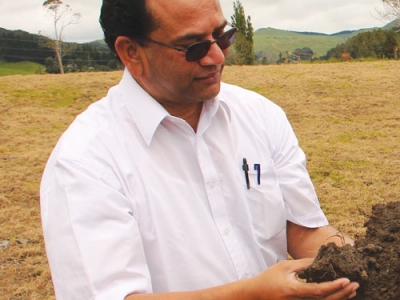 Waikato Regional Council’s Bala Tikkisetty is urging farmers to consider the impact of stock wintering on soil health and water quality.
Winter is a critical time for livestock farmers, with increased risk of erosion and sediment getting into waterways.
Stock compacting wet soils can reduce pasture growth and productivity, and bare soil caused by heavy grazing can be washed into waterways.
So it's a good time for dairy, beef and deer farmers to consider the impact of stock wintering on soil health and water quality. This should include livestock density, site selection and management of wintering systems.
Feed pads and stand-off pads are options for protecting soil physical structure over wet periods by preventing stock trampling pasture so heavily.
The feed pad is a dedicated concrete platform where supplementary feeds are fed to stock. Besides protecting pasture, higher feed efficiency is achieved as the wastage is reduced to about 5% as against about 20% and more when silage is fed in paddocks.
A stand-off pad is a dedicated loafing area for stock, with a softer free-draining surface of, say, wood chips. Since stock may be withheld from pasture for longer periods, the area required per cow has to be bigger, say, about 8 sq m.
Capture of effluent is an important aspect of stand-off pads. It requires that the humped and hollowed base is sealed underneath with compacted clay, an artificial liner or concrete, and the effluent directed into suitable sealed storage.
Animal shelters are an expensive wintering option but increasingly popular for convenience, animal welfare and productivity. They combine a feeding platform, stand-off facility and animal shelter. Sheltered feeding is done on slatted concrete floors. As the cows stand on the slatted floors, their effluent drops through the slats and into a concrete lined bunker beneath.
When building a wintering pad allow for solid and liquid waste disposal. Design the pad so that the contaminants run into your effluent management system. Locate the feed pad or stand-off pad well away from any waterway.
Sediment ponds can be placed downstream of wintering areas to contain peak storm flows. These ponds can capture sediment and particulate phosphorous. Soil particles need time to settle. Get professional advice on the right amount of settling time for your situation.
Sacrifice paddocks can be used when other options are not available, as a last resort, to stand animals off usual pastures when it is very wet, or as an area to feed animals hay and silage.
The disadvantages of sacrifice paddocks include soil structure damage and possible animal health problems such as lameness and mastitis. If soil potassium levels become too great (potassium is excreted in urine) it may also predispose the calving cow to metabolic problems.
In summary, it's suggested farmers focus on the following for soil and water protection:
Graze wettest paddocks in drier periods. Plan your stand-off strategy – especially if you have no constructed standoff facilities. Strip graze from the back of the paddock. Remediate winter-damaged areas through summer cropping. Leave good covers going into winter and leave buffer strips along drains and watercourses. Maintain races to reduce contaminants and make cut-offs to divert sediment into paddocks.
Do not feed out supplementary feeds in areas where runoff water may reach any water body. If possible avoid feeding out in these paddocks altogether.
• Bala Tikkisetty is a sustainable agriculture advisor at Waikato Regional Council. Contact him on 0800 800 401 or email This email address is being protected from spambots. You need JavaScript enabled to view it..
OPINION: "The worst thing that agriculture does is take land from nature."
With the pressure of winter and spring behind us, and the groundwork laid, now is a good time for many farmers to pause, check progress against plan, and think ahead to ensure resilience for whatever summer and autumn may bring.
OPINION: Soil is one of the most valuable assets that a farmer has. It is our collective responsibility to make use of soils without damaging either the soil or any other part of our environment, protecting them for our own use and use by future generations.
A study arising from a partnership with Ravensdown, AgResearch and Ngāi Tahu Farming, has created a benchmark approach to testing the health of soils.
OPINION: Good nutrient management will keep nutrients cycling within the farm system and reduce losses to the environment to the bare minimum.



LIC shareholders have elected a new North Island representative to the co-operative's Board, along with five representatives to its Shareholder Reference Group (SRG), following the company's Annual Meeting held in Invercargill.
Farmers across parts of Southland and South Otago are continuing to deal with difficult conditions after a prolonged run of wet weather, with pressure building around feed supply, stock management, pasture damage, farm infrastructure and everyday workloads.
Federated Farmers says it welcomes Labour's commitment to reviewing the Sharemilking Agreements Act, calling on other major parties to do the same.
For Canterbury dairy farmers Sian Meijer and Rick Wobben, wearable technology has become one of their most valuable on-farm tools - helping manage 1850 cows across an expansive, high-performing dairy operation while improving efficiency, mating outcomes and day-to-day decision making.
Fonterra has unveiled its annual results for the 2026 financial year, posting $27 billion in revenue and close to $20 billion returned to New Zealand farmer owners and unit holders.
The first major update to the Dairy Cattle Code of Welfare in more than a decade has been released, marking what DairyNZ describes as an important step in ensuring animal welfare standards continue to evolve alongside scientific evidence and on-farm realities.
OPINION: It seems Canterbury processor Synlait is still in the doldrums.
OPINION: Get offside with New Zealand First leader Winston Peters at your own peril.