
Almond Hulls Trialled to Cut Dairy Cow Emissions in NZ
Almond hulls sourced from Australian orchards may have the potential to help New Zealand cows reduce emissions, boost milk yield and lower input costs.




 increase font size
 ofi managing director dairy Sandeep Jain and ofi NZ general manager milk supply Paul Johnson at the new plant in Tokoroa.
The Singaporean conglomerate behind New Zealand’s newest milk processing plant says this is the first step in a long journey.
Olam food ingredients (ofi) managing director dairy Sandeep Jain told the opening of ofi’s new milk plant in Tokoroa this month that they were a “very growth-oriented company”.
“We are already committed to doubling our footprint in Tokoroa; we are committed to the community, our farmer suppliers and employees,” he says.
Three years ago, ofi, a new operating group of Olam, decided to build a milk plant in New Zealand. Jain says they were encouraged by the confidence shown in them by the South Waikato District Council and farmers.
“This made us realise that we were doing the right thing,” he says.
The new plant is producing whole milk powder to meet growing demand, targeting key global customer applications in dessert, bakery, beverage, and confectionery categories.
Jain says the new plant will become part of a global network that spans major milk consumption markets, such as South-East Asia, China, the Middle East, and Africa.
“Opening our new plant in the heart of New Zealand’s dairy region allows us to meet growing demand from our global customer base for high quality, New Zealand- made dairy ingredients and shows our commitment to exploring growth opportunities in our dairy product offerings, focused on valueadded capabilities within our portfolio,” Jain says.
“The plant will become part of our global network that spans major milk consumption markets including South-East Asia, the Middle East, and Africa, complementing our existing global footprint, driving greater collaboration with our customers and helping us achieve our purpose to be the change for good food and a healthy future.”
The company has signed farmers based within 60km of the factory. Paul Rennie, ofi operations director, says the positive response from local farmers and the community has been a humbling experience.
“The enthusiastic response we’ve received from local farmers tells us our partnership approach, and ofi’s global reputation as a leading dairy ingredients provider and innovator, has struck a chord with them,” Rennie says.
“Right from the start, our approach has always been to listen to what farmers want in a milk supply partner so we could tailor our offer accordingly. They told us they want a business partner who brings them confidence, certainty and cash flow, and hands-on solutions to the everyday challenges they face.”
Alongside an attractive milk price offer, ofi has also found innovative ways to support its farmer partners, with a focus on sustainability.
 |
|---|
|
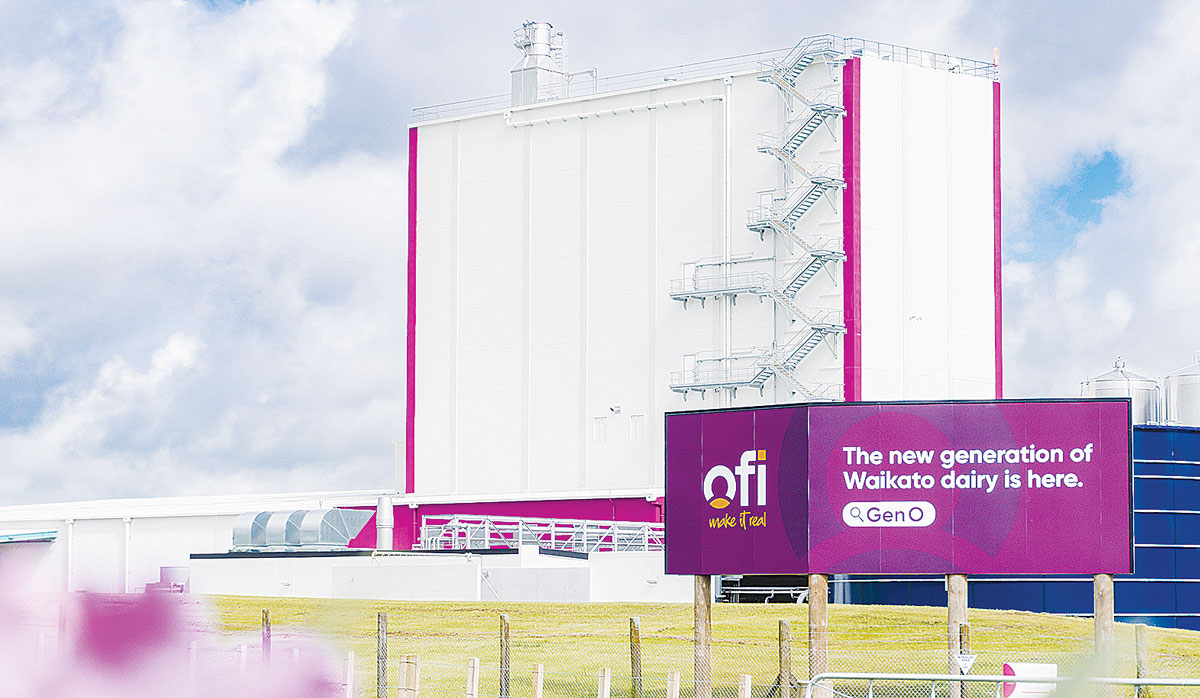
The new plant at Tokoroa took two years to complete. |
This includes coinvestment in advanced tools and technology to help ofi farmers actively monitor their environmental impact and achieve meaningful on-farm emissions reductions.
Construction of ofi’s state-of-the-art milk processing plant in Tokoroa, South Waikato, took two years and was completed in August. The first milk powder was produced at the new Tokoroa plant in August and the first shipment was exported in September. The plant employs 60 people, with 80% from Tokoroa.
Olam is no stranger to the NZ dairy industry. Olam held a cornerstone stake in the country’s second largest milk processor, Open Country Dairy, before offloading it to Talley’s Group, who now own Open Country.
The company says the new facility also complements ofi’s existing global footprint, driving stronger partnerships with its customers and strengthening its co-creation capabilities across the region.
The next stage of investment will see further capability added to the facility to develop high value dairy ingredients, expanding the range of ofi’s offering. It will also enable ofi to look at ways to grow the value of its milk, generating better returns for its farmer partners while delivering on its ambition to produce ingredients in a way that is socially responsible and environmentally sustainable.
Sustainability is Key
Sustainability is a core focus for ofi and is at the heart of everything it does, the company says.
A biomass boiler fuelled by sustainably sourced wood residue expected to be commissioned in Q1 2024 will power the plant enabling milk processing to be energy efficient and low impact.
In October, ofi published its first sustainability strategy for its dairy business, Dairy Tracks, which outlines the detailed approach the company is taking with sustainability efforts across its value chain.
The report shares how the company will meet industry challenges head on, providing direct support to its farmer partners to help them meet their goals to become more socially and environmentally sustainable by 2030.
AtSource, ofi’s sustainability insights platform, links ofi farmers’ environmental plans, greenhouse gas emissions and nutrient reports to its global customers to provide transparency across the supply chain.
ofi is pioneering a new animal feed trial that could help dairy farmers replace costlier and environmentally intensive feeds with a sustainable, forward-thinking alternative. It aims to repurpose almond hulls and shells – a by-product from its Australian orchards into a nutritious feed for dairy cows – to help cut farmers’ methane emissions and lower their input costs and reduce waste in ofi’s almond business.
Paul Rennie, ofi operations director, says all aspects of ofi’s new plant are designed to maximise renewable energy use, minimise pollution and water use and ensure waste is handled in the most sustainable way possible.
“We will invest in a biomass boiler fuelled by wood residue sourced from local forests to power the factory, ensuring milk processing is energy efficient and with a low environmental impact,” he says.
“Treated waste-water from milk processing operations will be re-purposed in an on-site nursery to grow cost-price native plants to help our farmers with riparian planting.”
Almond hulls sourced from Australian orchards may have the potential to help New Zealand cows reduce emissions, boost milk yield and lower input costs.
Farmers who have switched their milk supply to the country's newest processor say they are happy with the deal they have been offered.
New Zealand’s newest dairy plant was officially opened in Tokoroa this morning.
OPINION: Milking It understands the new Olam milk plant in Tokoroa is running slightly behind schedule.
Owners of a new milk plant under construction in Tokoroa say local farmers are showing a strong interest in supplying milk.


Mark Hooper has been appointed the new chair of NZPork, the industry organisation representing New Zealand pig farmers.

As the India-New Zealand free trade agreement enters into force, New Zealand’s apple industry has reaffirmed its commitment to the long-term development of India’s apple sector.
Fonterra shareholders can begin voting on Tuesday 20 October in the 2026 Board of Directors’ election, a Co-operative Council election in one Ward, and seven Annual Meeting resolutions.
National’s pledge to introduce 19 new national standards shows the party is serious about getting Wellington out of farming, Federated Farmers says.
The National Party’s policies to make it easier to grow fresh vegetables, secure reliable water and energy and simplify farm planning are practical changes that will give growers the confidence to invest, according to Horticulture New Zealand (HortNZ).
Fonterra Co-operative Group chief financial officer Andrew Murray has resigned to take up a role outside the dairy giant.




OPINION: It seems Canterbury processor Synlait is still in the doldrums.
OPINION: Get offside with New Zealand First leader Winston Peters at your own peril.




