
$10/kgMS Milk Price Looks Possible as Powder Prices Climb
A farmgate milk price of $10/kgMS this season is firming up as milk powder prices soar and the New Zealand dollar weakens.




 increase font size
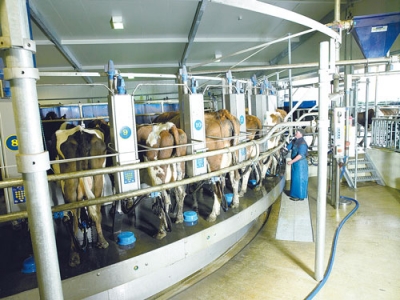 Slipping dairy prices continue to mount pressure on the milk payout for this season and next year.
Golbal milk price recovery could be "slow and painful", with doubts now cast over when the turnaround may come in the next season.
Rabobank analyst Emma Higgins says how quickly the brakes can be applied to global milk production is a key factor needed to lift global dairy prices.
She describes the international dairy markets as "fragile".
ASB is holding its $4.10/kgMS forecast for this season, but says both this and the next season's forecast of 6.50/kgMS are under review.
ANZ also says there's downward pressure on Fonterra's current forecast ($4.15/kgMS) and the opening forecast for 2016-17.
This follows last week's GlobalDairyTrade event which saw the price index drop by 7.4%, the third successive fall this year. Whole milk powder was down 10.4% to US$1952/MT.
Higgins says European dairy farmers are trying to find the optimum production level following the removal of quotas last year, which could take some time to rebalance.
"Added to that, New Zealand production has been stronger than was initially predicted," she told Dairy News.
"The additional production remains problematic: most of that milk needs to find a home on the international market or in stores, while demand remains weak."
Further contributing would be weak market sentiment stemming from the lower oil prices, she says.
"Oil-producing nations contribute to significant volumes of global dairy trade and are hurting from reductions in government incomes as a result of the slump in prices," she says.
"Not only will low oil prices have an effect upon these countries' ability to continue purchasing, but many of these buyers are now well stocked anyway.
"Many net oil exporters have taken the opportunity to fill inventory pipelines at the low prices seen in 2015 and therefore these buyers are well stocked at present.
"We expect an improvement in global milk pricing by the end of the year – albeit slow and painful. However, we remain conscious of the volatility in commodity markets and, in particular, the fact that international dairy markets remain fragile."
ASB, which dropped its forecast for this season from $4.60/kgMS to $4.10/kgMS after the previous event, is holding that forecast at present, but it's under review. The 2016-17 forecast is also under review.
ASB rural economist Nathan Penny says surprisingly good NZ weather is supporting milk production so far this summer.
"This El Nino is looking like a fizzer. Most parts of the country have had good rain this summer. Indeed green is the countryside's summer colour of choice, even in areas like the East Coast where brown is normally the summer vogue," he says.
The good NZ growing conditions have come as a surprise, he says. Weather analysts had labelled this El Nino as one of the strongest in recent memory. But instead of the dry summer "slamming the brakes" on NZ production, the slowdown is happening at a more gradual pace. "In an oversupplied global dairy market, gradual is not fast enough."
The long term view remains positive.
ANZ rural economist Con Williams points out that GDT prices are down 12% since the start of the year, with cumulative falls of 31% since last October.
"The price action was weak, with the upward sloping curve for WMP now no longer evident. At this stage it is difficult to see an imminent turnaround in prices and it places pressure on Fonterra's (already downwardly revised) milk price for 2015-16 and will weigh heavily on the opening milk price forecast for 2016-17."
A farmgate milk price of $10/kgMS this season is firming up as milk powder prices soar and the New Zealand dollar weakens.

A 'tsunami' of milk from key exporting countries is winding down and this may be good news for New Zealand dairy farmers.
Kiwifruit growers are watchful but remain optimistic as concerns around the potential effects of the El Niño weather pattern this season.
Milk powder prices are keeping farmgate prices up, helping processors offset the dip in milk fat prices.
Case IH has unveiled its redesigned next generation Puma Series tractors, said to offer improvements in connectivity, operator comfort, fuel efficiency and drivability.


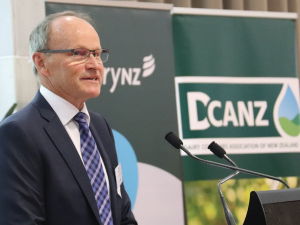
Dairy processors are ready to further boost New Zealand’s export earnings but want the incoming government to match their ambition with good policy.

Massey University is best placed to solve the “problems” facing the dairy industry, says vice chancellor, Pierre Venter.
Synlait's longest serving employee – a man who joined the Canterbury-based milk processor even before it began processing milk – is now its newest executive.
A dairy industry leader believes eradicating the common and costly disease, Bovine Viral Diarrhoea (BVD) is within reach.
A farmgate milk price of $10/kgMS this season is firming up as milk powder prices soar and the New Zealand dollar weakens.
Federated Farmers has welcomed new rural policies released by ACT, saying they align closely with its own election priorities.




OPINION: It seems Canterbury processor Synlait is still in the doldrums.
OPINION: Get offside with New Zealand First leader Winston Peters at your own peril.




