Friday, 31 July 2026 07:55

Calf Rearing Facilities: Housing, Spacing & Hygiene Guide

Written by  Staff Reporters
Young calves should be housed for at least four weeks to ensure they stay warm and are using their energy for growth. Young calves should be housed for at least four weeks to ensure they stay warm and are using their energy for growth.

Rearing facilities should be set up and maintained well to ensure calves stay healthy.

Young calves should be housed for at least four weeks to ensure they stay warm and are using their energy for growth.

Housing

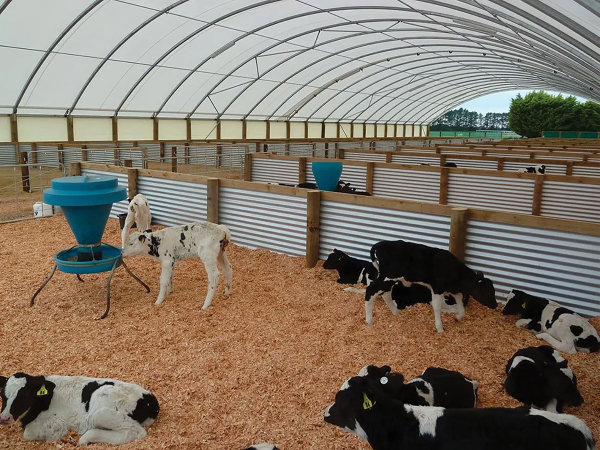
  • Must be dry and draught-free for calves to regulate body temperature. Calves should be protected from wind and rain in a structure twice as long as wide.
  • Cover the floor surface with dry materials such as sawdust, shavings, straw, post peelings or wood chip to a depth of at least 200-300mm. Avoid dusty materials and the use of river stones.
  • Ideally, the floor should be lower at the front to help drain effluent and water. Regularly muck out and top up bedding so it is clean and dry.
  • Good ventilation is essential and is best situated where the walls meet the ceiling. It's easier to ventilate across the shed, not down the length. Ventilation should be adaptable, so the use of boards, shutters or wind cloth is recommended.

Spacing Calves

  • Calves are less stressed and have higher intakes in smaller groups. The shelter should provide a minimum of 1.5m2 per calf and, where possible, minimise calf contact between pens. The best approach is 10-20 calves per pen.
  • Depending on how many calves you are rearing - having more than one shed separated into pens allows for easier separation of age groups and feeding levels. Having more pens also provides a safety barrier between calves in case of a disease outbreak and will allow a pen/shed to be rested for cleaning and sanitation between different batches of calves.

Feeding Facilities

  • Each pen must have clean, quality water, which should be checked, cleaned and refreshed daily. In hot conditions, restricted feeding systems, high meal/fibre intakes or scours, an additional 2-6l of water per calf per day is required.
  • Meal troughs should have sufficient space for feeding at least half of the calves at the trough at any one time. Provide a minimum of 300mm of trough space per calf.
  • Keep meal feeders free from moisture and clean weekly to avoid fungal growth.
  • Keep milk lines as short as possible and ensure there is no stale milk left in hoses between feeds.

Cleaning

  • Ensure all feeding equipment is regularly cleaned and treated with disinfectant. Bottles or cafeterias should be cleaned between feeds and automatic feeders (mixing bowls, lines and teats) should be cleaned and calibrated at least weekly.
  • Use a broom to remove any excess material in laneways. Do not use a high-pressure hose inside the shed, as this will aerosol bacteria and viruses to calves in other pens.
  • Spray the rearing area, feeding utensils and teats with approved virucidal at least once a week and daily during a disease outbreak.
  • Rodents and birds must be controlled.
  • Isolate sick calves to reduce risk of spreading disease.

Post-Colostrum Feed

Following the colostrum period, calves should be fed clean whole milk from the vat or a good quality calf milk replacer (CMR). Fortunately, research has shown that calves can thrive on a good-quality CMR.

  • Start initial feeding two hours after arrival with warm milk or electrolytes.
  • Consider a quality probiotic to help calves transition to their new environment.
  • Check teat quality (replace if damaged) and quantity - there should be spare teats on each feeder, e.g. eight calves to a 10-teat feeder.
  • Clean the feed equipment and teats after each feeding.
  • Check for slow-drinking calves that struggle to compete within the group. If necessary, re-group calves on drinking speed and vigour.
  • Check milk temperature. Feeding warm (38-40°C) is recommended.
  • Clean, fresh water must be available ad-lib from day one.
  • Calves should be fed at the same time each day.
  • Offer a good-quality forage source (e.g. chopped grass hay, pasture, chopped silage), plus a grain-based starter, from week 1. The solid feed offered should be tailored to suit the rearing system selected. Calves can be reared successfully on high levels of milk (e.g. 8L/day) plus good-quality forage.

More like this

Three Pillars of BVD Control

Solid biosecurity practices, regular monitoring and timely vaccination are the three key pillars of effective Bovine Viral Diarrhoea (BVD) control on New Zealand farms. Zoetis veterinary technical advisor, Karley DeFrees, explains BVD is a costly but preventative disease that impacts a significant number of dairy farms in New Zealand. Implementation of a BVD control plan can help protect your herd from this avoidable disease.

Sharemilkers Credit DairyBase Tool for Staffing Decisions

Signing up to a benchmarking tool is not about competition, but about improving collectively, says Ximena Puig and Alvaro Luzardo who are 50-50 sharemilkers at a 164-hectare (effective) dairy farm in Eketāhuna in the Lower North Island.

Clostridial Disease in Lambs: NZ Vaccination Guide

Although preventable, lamb loss from clostridial diseases during the first year of life on New Zealand hill country farms continues to be an issue. A field trial, where lambs were vaccinated at docking and weaning, demonstrated that vaccination was highly effective, lowering clostridial deaths by 23%. Zoetis veterinarian Dr Victoria Chapman unpacks the importance of robust animal health programmes, vaccination timing and the potential harmful consequences for stock when vaccination isn't given.

BVD Control in Dairy Herds: How to Find & Remove PI Animals

Bovine Viral Diarrhoea (BVD) is estimated to cost New Zealand's dairy and beef industries more than $150 million every year, yet many of the tools needed to control it are already well understood. After more than 25 years in veterinary practice, Andrew Weir, animal health technical specialist at LIC, has seen firsthand the impact BVD can have on herd performance. We asked him about the role of persistently infected (PI) animals and the practical steps farmers can take to reduce their risk.

Featured

Sharemilkers Credit DairyBase Tool for Staffing Decisions

Signing up to a benchmarking tool is not about competition, but about improving collectively, says Ximena Puig and Alvaro Luzardo who are 50-50 sharemilkers at a 164-hectare (effective) dairy farm in Eketāhuna in the Lower North Island.

National

Machinery & Products

» Latest Print Issues Online

Milking It

Irish Dilemma

OPINION: The Irish dairy sector is facing a new dilemma - maintaining year-round fresh milk supplies.

Beef Cows To The Rescue

OPINION: Could beef cows play an increasingly important role in improving profitability and resilience on hill country farms?

» Connect with Dairy News

» eNewsletter

Subscribe to our weekly newsletter