
If it isn’t dealt with, it can often travel through a team to other members.
It’s disappointing when someone has a young pup full of potential, with no bad habits and when it joins the team at work Mother Nature takes over its brain and says ‘watch – learn – copy’.
Working too close, rushing or cutting in, biting and peeling off the slow, etc are all unacceptable behaviours for a working dog, and they’re often learnt in seconds from an old hand; unless dealt with immediately they’ll probably stick with the dog for its working life.
If you run pups with older dogs in order to train them, they will pick up the bad with the good; however if you train pups separately, without other dogs, you can avoid bad habits forming and correct mistakes as they happen – if you know what you are doing.
Bad traits in older dogs usually stem back somewhere to a handler, either with bad training, non-existent training or inconsistent training.
I am often asked at my clinics if ‘problems and habits’ can be cured, in other words, can you retrain a dog? Yes, if you know what you are doing and you are patient, clear and consistent with your dog; most things can be improved or cured. Worrying, no, the only solution is a bullet.
Some of you may have dogs that have been going to work for a year or two, but they are limited in what they can do. Can you add to their repertoire? Yes, you can easily train an old dog to have a few more tricks; it comes down to your knowledge and ability as a trainer.
It is important to me as a teacher to explain to people why they need to do something when training a dog, and what may happen if they don’t do it; people are likely to have far greater success if they fully understand the complete procedure and the logic behind it, especially when one lesson leads on to the next.
Everything I do is done for a reason; there is method to my madness.
Each lesson is easy for the trainer to understand, easy to orchestrate and if done correctly the desired result will happen before too long, in most cases.
If a dog trainer is confused, the message they give their dog will be muddled and probably impossible for it to understand. Clarity, consistency and repetition are vital for any learning, along with patience, kindness and the ability to correct in the right way at the perfect moment. Timing is critical.
Every dog I train has a number of lessons on a rope, so that I have total control of the dog and can guide it with my training stick when I teach a new command.
Most lessons are done on either a flank rope or harness because if the rope is attached to the collar, and correction applied, the result will be either pulling the dog away from the stock towards you (undesirable in most cases) or it will put potentially harmful pressure on a barking Huntaway’s vocal cords, sometimes resulting in a damaged bark -- something a lot of people are unaware of.
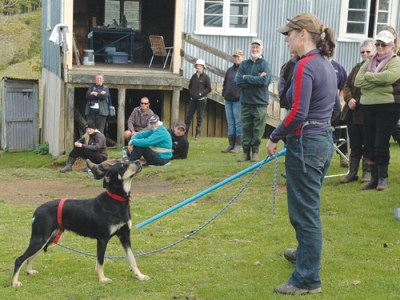
In the above photo Eve demonstrates her stop: standing square and still, facing forwards and not moving as I stand behind, out to the side or in front of her. Her posture is perfect – relaxed, attentive and respectful.
• Anna Holland is teaching people dog training. For more informationwww.annaholland.co.nz or Ph. 06) 212 4848 or This email address is being protected from spambots. You need JavaScript enabled to view it.