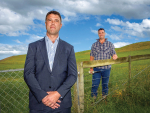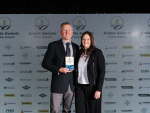
McCaws Named 2026 Arable Farmers of the Year
The arable sector losing good people and land is a major concern for the 2026 Arable Farmers of the Year, Mid Canterbury seed growers John and Mel McCaw.




 increase font size
 Milk shed and feed pad nearing completion.
A major dairy conversion, transforming 2500ha of forestry into five farms near Taupo, is on track to start milking on August 1.
Ata Rangi Pastoral Ltd aims to produce 3 million kgMS from the five farms by 2020.
Owned by two Kiwis -- farmer Gerard Donald and financier Brent Cook – Ata Rangi last year bought 5732ha of forestry in Whakamaru. The farms will stretch from Tokoroa to Whakamaru. About 2400ha will remain in forestry, 500ha will be cropped and grazed and 233ha riparian planted.
Contractors are busy clearing land, removing stumps, cultivating grass, building milking platforms and lining effluent ponds.
Ata Rangi general manager Stephen Veitch says contractors were working six days a week to ensure the Atiamuri farm started production on August 1.
About 1600 cows now grazing off site will moved to the farm on August 1. Each farm will have 1500 cows – three cows/ha. Cows will be moved between farms as each farm comes on line, Veitch says.
Milk will be supplied to Fonterra on six- and 10-year contracts, allowing the company to stagger the purchase of Fonterra shares over this time.
Sustainability is a major focus for Ata Rangi; main contractor J Swap has used a GPS-guided digger to outline the farm according to three rules: no disturbance of slopes greater than 25 degrees, no discharge of soil or sediment into waterways (a 10m boundary has been set around waterway sites) and there is a setback of 25m from the Waikato River and lakes.
Veitch says Ata Rangi is building a business that is economically and environmentally sustainable. Transparent communications with local councils and iwi is part of its strategy.
“The project was finalised quickly and we kind-of popped out of the blue; so there were a lot of questions from the community, some of whom don’t support forestry conversions.
“We’ve had several meetings with the local iwi -- Raukawa Charitable Trust -- and the local regional councils to set the record straight. We strongly believe economic and environmental sustainability go hand-in-hand; you have to be in the black to be green.”
Ata Rangi is transparent about its water use; telemetry will be used to measure surface and groundwater takes.
“By shutting off valves we can only take 30 cumecs (m3/sec) out of the the river and 15 cumecs out of the bore holes; this information will be in the cloud for everyone to see and is part of our transparency policy.”
Each farm will have weeping wall effluent management; solids will be separated from the liquid before the pond and irrigation on the land.
Gibson Construction is the dairy shed builder and Waikato Milking Systems is providing the milking gear. About 54 machines and 70 people are involved in the conversion.
Veitch says co-owner Gerard Donald has worked with the companies below on projects.
He says J Swap is providing two out of the six crews. “We find J Swap very helpful; they have a site foreman who is our first point of contact. They have experienced operators and good machinery with few breakdowns.” This is important because time is tight.
Confident in the future
The developers of the Ata Rangi Pastoral project near Taupo are taking a long term view, says general manager Stephen Veitch.
This is that their Kiwi-owned family asset will pay dividends long term.
The low payout is on their minds but they are confident prices will bounce back by the time the five farms are in full production, he says.
“One of the owners is a dairy farmer and the other a financier; they have researched the industry at length and have looked at supply/demand demographics.
“They are taking the long term view; while we’re developing in a low payout environment we believe in the payout coming up as we get into production.”
However, Veitch says the owners are reviewing the farm systems and discretionary spending.
“We are forecasting 3 million kgMS with a system 3 and 4; we are reviewing the cost of additional feed going in and whether we pull it back to a system one or two.”
Long term view for environment
Ata Rangi Pastoral Ltd was founded this year by Brent Cook and Gerard Donald.
The company was set up in response to growing demand for quality protein worldwide, particularly in Asia, and the changing tastes of wealthy consumers.
“This has created increased demand for the high quality, safe food New Zealand farming systems are known for. ARPL is a long term project to produce [such] food in a sustainable, innovative and economic manner for the benefit of NZ.”
Ata Rangi says its farms signify a new beginning, or ‘dawn sky’, reflecting the transformative nature of land conversion: land in forests since the 1920s will be livestock pastoral farms.
ARPL’s environmental plans are:
The arable sector losing good people and land is a major concern for the 2026 Arable Farmers of the Year, Mid Canterbury seed growers John and Mel McCaw.
OPINION: Canterbury grows most of the country's wheat, barley and oat crops. But persistently low wheat prices, coupled with a high milk payout, are believed to be driving farmers out of the industry in the hunt for the dairy dollar, according to media reports.
Dairy conversion has taken on a whole new meaning around the small Horowhenua township of Otaki.
Developers of a big dairy conversion near Taupo are doing everything by the book – consulting local councils and iwi, sticking strictly to environmental guidelines and transparently communicating with locals.


Federated Farmers has welcomed new rural policies released by ACT, saying they align closely with its own election priorities.

Rural Contractors NZ says proposed changes to land transport rules for agricultural vehicles are a welcome response by the Government to out of date regulations which have seen members hit with huge fines.
Alliance is calling for final applications for its 2027 Graduate Programme, with applications closing on Sunday 25 October.
Decades piloting planes has ensured vet and farmer David Hayes is focused on safety. So, after a serious accident while welding on farm, he is sharing his experience so others can learn from it.
Canterbury milk processor, Synlait Milk has confirmed Leon Fung as its chief executive officer.
OPINION: Making it easier to collect rainwater and use it to grow crops and livestock is a no brainer.

OPINION: The same mainstream media muppets that brought you Jacindamania in 2017 have been flat out pimping for the Opportunities…
OPINION: Your old mate reckons the atrocious way farmers in the UK are treated by their lords and masters in…