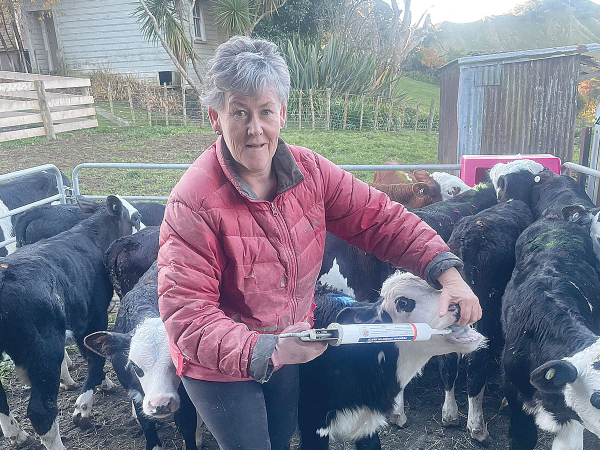
Within five days of picking up her calves in August 2020, Taihape farmer Sandra Fannin knew she was going to have trouble.
“We had tummy upsets, one calf went down quickly, and we lost it overnight. They smelt terrible and very quickly they were all sick – it was the beginning of a nightmare,” Fannin recalls.
She reached out to Probiotic Revolution and the vet. A poo sample confirmed that the calves had very high counts of rotavirus and crypto.
“My vet told me I was in trouble, so I went home with hundreds of dollars of electrolytes, and he wished me luck. One of the calves was so sick, it could hardly stand and because my probiotics had arrived, I gave it and all the others an immediate double dose of BioRescue paste and Calf Xtreme in the feed that night.
“I was amazed the next morning to see that calf standing waiting for a feed. At lunch time the sick calf got more paste and electrolytes. That night they all got a double dose of Calf Xtreme and the next morning they were all pretty much fine.”
Fannin continued with the double dose for about five days and could not believe how these calves had changed. They had nice shiny coats, and very soft hair, and they were all happy and would bounce around the pens.
“About three days later the vet phoned and asked how I was getting on, and how many more calves I had lost. When I replied, ‘none’, he couldn’t believe it,” Fannin says.
Although Fannin is a seasoned calf-rearer, she notes that these probiotics have revolutionised her calf rearing system.
She rears up to 40 Friesian-Hereford calves each autumn and 30 in the spring. She gets them to a target weaning weight of 80 – 85kg about a week earlier, in only 42 – 50 days. By then 36 calves will be smashing back one and a half bales of hay and 40kg of calf meal. They also hold their condition better and do better after weaning.
“There is no way I’m going back to what I did before,” she says.
Better health and growth rates of young calves has also led to changes to the Fannin’s cattle policies on their Taihape hill country farm.
We get these steers to 600kg by the time they are 2 years of age so the calves we rear in the autumn don’t have to go through another winter.
“If we pushed them, they would get to slaughter weights in 18 months, but there are times when we just have to hold them back a bit.”
Because the Fannin’s calves have been on probiotics up to weaning it has boosted their immune system minimising the need for drenching. “We used to drench them monthly. Now it’s only 2-3 drenches and sometimes only the ones that look like they need it.”