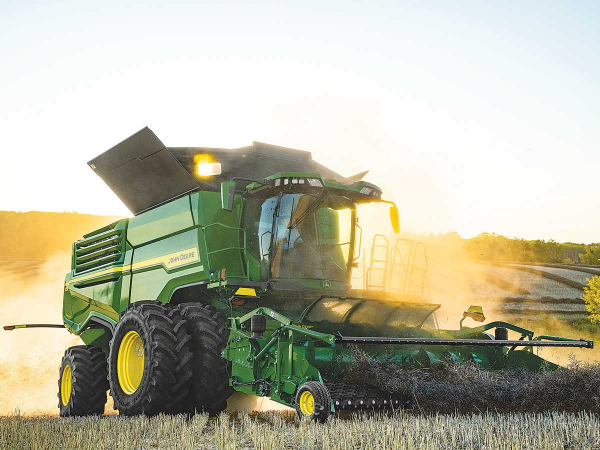
John Deere has updated its entire header line-up for combines to include the new HDR Rigid Cutterbar Drapers, RDF HydraFlex Drapers, a BP15 Belt Pickup, and CR and CF Corn Heads.
Compatible with most S, T and the new X Series harvesters – and available alongside the 700D drapers – the headers are designed to prevent grain loss and provide an even feed to help achieve maximum harvesting capacity under a wide range of crops and conditions.
HDR Rigid Cutterbar Drapers are said to be ideal for small grains, canola and pulses. These are particularly suited to changing conditions, uneven or rolling terrain and for down or lodged crops.
“A new hinged frame provides unmatched terrain-following capability with twice the wing range as a MacDon FD1 FlexDraper, and with uniform cut height,” says John Deere’s Marko Koelln.
The drapers pick up, sweep and recover more crop, thanks to a consistent distance between the reel fingers and cutter bar, an improved reel range and increased reel-drive motor torque. Optional Grain Saver Draper Belts can also help to reduce canola cutter bar loss by up to 25% compared to traditional, smooth draper belts.
HDR Drapers are available in 10.7m, 12.2m, 13.7m (45ft) and 15.2m cutting widths.
RDF HydraFlex Drapers are built on the field-proven cutting technology of the existing JD Deere 700FD, while providing new features to reduce grain loss. All RDF HydraFlex Drapers feature a new Two-Speed Centre Feed Section that lets operators slow down the feed drum and centre feed belt by 20% compared with the 700FD.
This is said to put more grain in the tank by reducing free grain losses. It also allows operators to move from low to high speed when direct heading canola.
Excellent cutting quality is carried over with the use of the 10cm double-cut, dual-drive shaft HydraFlex Cutterbar. This provides 1980 cuts per minute to enable faster harvesting speeds. A choice of a standard centre belt is recommended for crops like soybeans or the optional cleated centre belt to feed higher-volume crops, like canola, into the feed drum.
The BP15 Belt Pickup is for small grains and canola growers who need to harvest more hectares per hour. It delivers a 20% faster feed rate than its predecessor, the 615P.
New features include a wider feeder-house opening with adjustable feed auger flighting and fingers, improved feed rate adjustability and a standard two-speed auger drive sprocket. A slower-speed feed rate can be used for less bulky crops like cereals and grass seed. Meanwhile, a factory-installed crop shield minimises grain loss by preventing a build-up on the feeder housing.
A new line of Corn Heads has also been developed, including CR Rigid Corn Heads that can be equipped with Active End Fenders that pull more ears into the head. This is particularly useful for leaning or lodged crops. CF Folding Corn Heads also include a low-profile folding frame, giving a fold cycle time of less than 60 seconds and eliminating the need for a header trailer.
Each of the new headers is equipped with a header control unit (HCU) that communicates with the combine to save head-specific calibration settings. This sends width information for accurate yield mapping, oversees header diagnostic codes, and tracks hours of use and maintenance intervals.