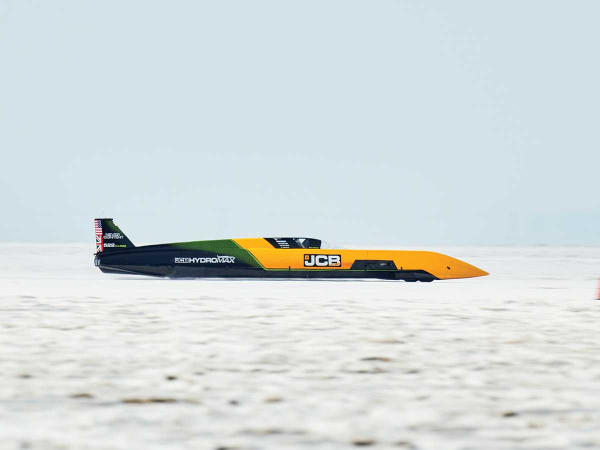
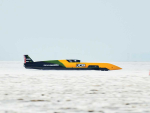
JCB has set a new world land speed record of 406.320mph with its hydrogen-powered Hydromax.
Blitzing the previous FIA-officiated hydrogen internal combustion benchmark of 185.5mph set by the BMW H2R in 2004, the record was achieved using two of JCB’s own production-based hydrogen digger engines, producing a combined 1600bhp.
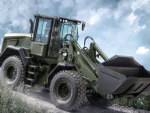
Manufactured at the company’s engine plant in Foston, Derbyshire, the same basic engines are currently powering JCB machines and equipment rolling off UK-based, Foston production lines, as part of the company’s £100 million hydrogen programme.
Driven by wing commander Andy Green OBE, the 32-foot car recorded an average speed 400.623mph in its first run across the Bonneville salt flats, and 412.135mph on its second run, giving the average of 406.320mph – the fastest a hydrogen internal combustion car has ever travelled. Green was also the driver of Dieselmax when it set the, still standing, FIA world diesel land speed record of 350.092mph at the same location in 2006 and remains the only person to have broken the sound barrier on land
JCB is no stranger to breaking records and in addition to the Dieselmax success, the Fastrac became the world’s fastest tractor at 135.191mph in 2019, and in 2014 the GT set the backhoe loader record at 72.58mph.
Looking at the Hydromax’s specifications, its twin, 4.8 litre, turbocharged four-cylinder engines, sees a four wheel-drive layout, with one unit powering the front wheels and the other the rear. A steel lattice chassis is encased in an extremely aerodynamic carbon fibre skin over its 9.8m length and tipping the scales at 2.6 tonnes.
Developed in just over a year, with intensive testing in the UK before heading to Bonneville. The car features advanced cooling systems, including ice and water to manage engine temperatures, and a six-speed racing gearbox controlled via paddle shifters. The project focuses on JCB’s commitment to hydrogen technology for heavy machinery, showing practical applications of zero-emissions technology.
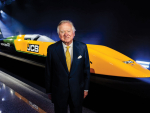
Having led JCB’s hydrogen engine project, Chairman Anthony Bamford came up with the idea of the hydrogen World record in 2025. Lord Bamford commented, “Twenty years ago we came to Bonneville with JCB Dieselmax and showed what British engineering could do with diesel power. Today we have done it again — this time with engines powered by hydrogen-the same engines powering JCB diggers right now.”
The record comes ahead of the opening of JCB’s new $500 million factory in San Antonio, Texas, which will employ 1500 people manufacturing machines for the US market.
www.jcb.co.nz