
Lanaco and Blueair Launch World-First NZ Wool Air Filter
New Zealand wool is reaching new heights as air filtration companies move away from synthetic products to biodegradable alternatives.




 increase font size
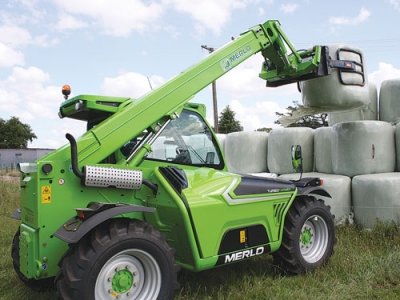 The saying goes: you didn't realise you needed a telehandler until you bought one.
The saying goes: you didn't realise you needed a telehandler until you bought one.
But there's no doubt this type of machine has revolutionised material handling on farms – with far greater capacity and manoeuvrability than traditional tractor/loader set-ups.
Italian specialist Merlo is credited with developing the first machine of this type as far back as 1981, when it combined the features of a fork truck with those of a telescopic boom crane to create the SM 30.
Merlo, always particularly innovative in this field, has recently introduced the new Series 11 Turbofarmer with a raft of new features that will no doubt keep it ahead of its competitors.
A new modular design for the main frame area still sees the centre section protected by the Merlo 'ring of steel" but allows the factory to build machines with a choice of 7 or 10m boom assemblies for differing market segments. The same ethos applies to the engine bay, where the power unit sits in a cradle that can be 'dropped' into the mainframe easily, dependent on required specification.
First models to be introduced to the NZ market are the TF38.7-100 and the TF 38.7-120, which lift 3.8 tonnes to a maximum height of 7m, powered by a 100hp Kubota, or 120hp Deutz Tier 3B power-plants.
Engines are mounted low on the offside of the units, cooled by a new package that draws in air from the side and discharges hot air out through the top surface of the hood. A reversible fan system ensures that direction of flow is changed periodically to keep everything clean and running at the optimum temperature.
Also receiving attention is the familiar hydrostatic transmission with an Eco Power Drive (EPD) that allows the operator a choice of transmission strategies dependant on the task at hand. The 'heavy load' choice gives full power for the most arduous tasks, while the ECO mode limits the maximum engine speed to 1800rpm and should prove useful for road work and around the yard.
Switching to the 'speed control' function allows the driver to control speed with the drive pedal, and the engine will increase or decrease its speed to maintain the desired setting. The resultant savings see an average reduction in engine revs of about 25% and worthwhile fuel savings of about 18%.
Telehandlers rely on a decent hydraulic system to make the job easy, and the TF 11 takes care of this with a 105L/min gear pump system on the 100hp unit and a high output 170L/min featuring closed centre/load sensing and proportional joystick control
Also included as part of the NZ package is the unique Merlo CDC system that ensures that any loads being lifted are within the safe limits of the machine, and advises the operator in pictorial and audible format. The system also offers the ability to weigh at any point during vertical or horizontal movement of the boom with +/- 3% accuracy. This has proved useful for livestock operators weighing feed, or arable operators moving crops in and out of store.
The all-new cabin sees the same width, but greater length, and features curved glass for improved forward and upwards visibility, an air suspension seat and a high output air conditioning system. Controls are laid out logically in front and to the driver's right, and feature a colour screen for engine and transmission readouts and a large 'A' pillar screen for load, safety and rear view camera functions. The cab is remarkably quiet with only a small amount of hydrostatic noise.
A wide range of options can be factory fitted such as cabin or boom suspension, boom sideshift, and a newly released choice of rear PTO and hitch, for models over 120hp, without the need to go to multi-farmer spec.
New Zealand wool is reaching new heights as air filtration companies move away from synthetic products to biodegradable alternatives.

Generative AI in the workplace, trials in the field, and industry-relevant research took centre stage at this year’s Grape Days events in Central Otago, Hawke’s Bay and Marlborough.
Power Farming has launched a joint venture in Southland.
Morrinsville-based agribusiness leader Geoff Maber has been appointed an Officer of the New Zealand Order of Merit (ONZM) in the King’s Birthday Honours, recognising a lifetime of service to agribusiness, the rural sector and the wider community.
Waikato agribusiness leader Geoff Maber has been appointed an Officer of the New Zealand Order of Merit (ONZM) in the 2026 King's Birthday Honours.


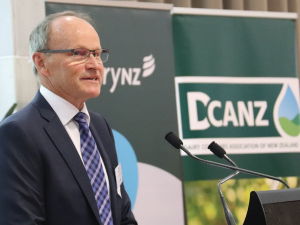
Dairy processors are ready to further boost New Zealand’s export earnings but want the incoming government to match their ambition with good policy.
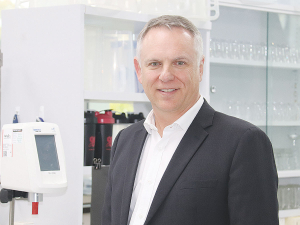
Massey University is best placed to solve the “problems” facing the dairy industry, says vice chancellor, Pierre Venter.
Synlait's longest serving employee – a man who joined the Canterbury-based milk processor even before it began processing milk – is now its newest executive.
A dairy industry leader believes eradicating the common and costly disease, Bovine Viral Diarrhoea (BVD) is within reach.
A farmgate milk price of $10/kgMS this season is firming up as milk powder prices soar and the New Zealand dollar weakens.
Federated Farmers has welcomed new rural policies released by ACT, saying they align closely with its own election priorities.

OPINION: The same mainstream media muppets that brought you Jacindamania in 2017 have been flat out pimping for the Opportunities…
OPINION: Your old mate reckons the atrocious way farmers in the UK are treated by their lords and masters in…




