At a recently held sustainability day in Germany, John Deere unveiled the latest updates for its eAutoPowr, electric infinitely variable transmission, the first of its kind in the world and now available for the 8R tractor range.
The electric drive is designed to supply drive to the tractor, while also providing up to 100kW of electrical power to external implements, using two brushless, electric motors, that according to the manufacturer, are “virtually wear-free” and will last the lifetime of the machine.
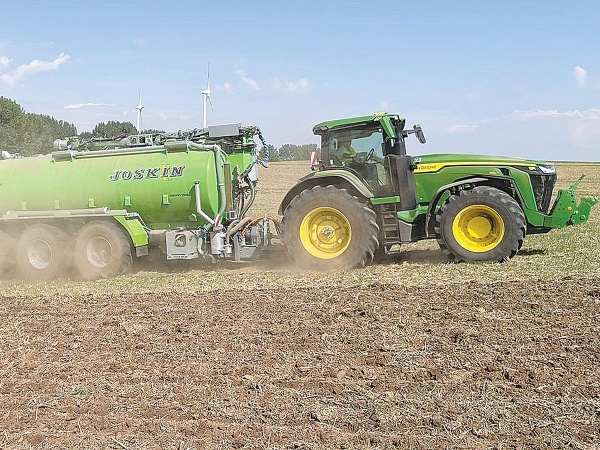
Working in partnership with Belgium transport and effluent specialists Joskin, Deere has developed a system that allows up to 20% of the electric power to be redistributed to two axles on a Joskin slurry tanker. This is said to increase traction in poor ground conditions or when climbing inclines, helping to protect the land from sub-surface caused by wheel slip.
In other sustainability news, Deere is also aiming to have electric drive alternatives in every John Deere product family by 2026, with a further plan to launch a fully autonomous battery-powered electric tractor in the under- 100hp class with the same timing.
Deere has also been developing a MultiFuel concept to allow its engines to run on biofuels, traditional diesel or fuel blends. The ‘one-tank solution’, is suitable for any fuel in both pure and blended form, including farm-produced plant oils.
In operation, different fuels are recognised by sensors of the standard combustion engine and the exhaust gas after-treatment system. These deliver the data for a mathematical-physical model and for an artificial intelligence – based approach recognising the different fuel mixtures.
Based on this, the electronic engine control unit (ECU) selects the appropriate software setting for optimal engine operation, while also allowing the engine to comply with Tier 4 emission standards.