Research suggests that up to 40% of a tractor’s time is spent on haulage duties.
This means that, over the years, farm trailers have evolved from single axle units with 4-tonne capacity to the goliaths of today – equipped with two or three axles and capacities of 18 or 20 tonnes.
In the case of the latter, their sheer size means they are likely to impose huge loads on the tractor, have tipping restrictions in areas of low headroom and the likelihood of high oil take-out requirements, caused by needing to fill large hydraulic cylinders when tipping. More recently, smarter operators are seeing the benefits of compactor/push-off trailers that offer benefits of higher capacity and quicker safer discharge.
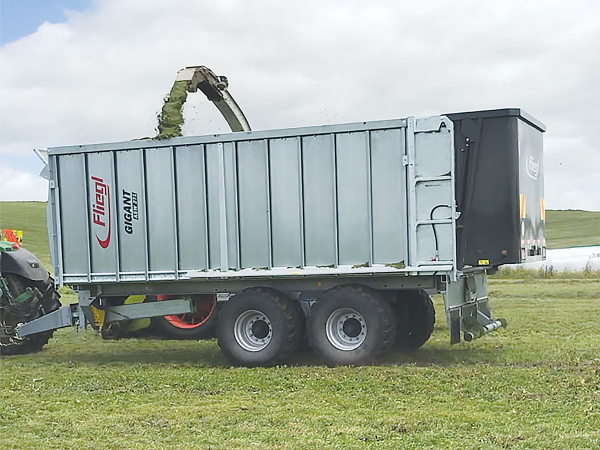
In the case of haulage specialists Fliegl, who first introduced this concept in 1999, their ASW 271 Gigant is a great example of an all-purpose trailer designed to deal with a wide range of produce. This includes grass and maize silage, potatoes, manure, compost, woodchips and gravel. Built around a substantial ladder-frame chassis, the trailer is mounted on the company’s Gigant Plus trailing-arm suspension system that is mounted on rubber bushings. This offers maintenance-free operation, the ability to deal with high axle loads, high speeds and maximum stability.
The trailer incorporates Fiegl’s two-stage push-off system that sees a moveable front wall initially compressing the load or discharging when the rear door is opened. Load compression allows the operator to move the nominal load of 35 cubic metres rearwards and effectively increase that volume to that of a 56 cubic metre body, using a minimal take out of only 21 litres.
Material is contained in the body of the trailer by using angled polyurethane sealing strips, with a life expectancy of five to ten years.
Once filled, the trailer can be typically emptied in around 40 to 50 seconds, depending on material. All the while, maintaining a low centre of gravity, ease of access and discharge in limited headroom and up to 60% more volume than a standard trailer.
With a maximum load capacity and a tare weight of 6,900kg, the novel layout only requires a tractor of around 160hp. The trailers have an added bonus of mechanical axle adjustment, which allows optimal weight distribution. This moves the axle assembly rearwards and places more weight on the tractor, so improves traction in field conditions, while the reverse makes for a more comfortable ride during haulage at high speeds.
Measuring 7.1m long, 2.28m wide and 2m high, standard equipment includes 300mm high removable silage extensions, a 500mm folding side panel and an 800mm deep, hydraulic rear door. Axle equipment is a BPW 410 x 210mm, with a fixed forward axle and a rear steering unit to help reduce scuffing. Tyres are 560-60 R22.5 flotations, with the trailer hitched to the tractor via a hydraulically suspended drawbar and a 50mm swivel eye coupling.
For those operators looking to customise their trailers, options include 650-65R26.5 or 710-50 R26.6 tyres that can help reduce compaction and deliver a more comfortable ride.