Just prior to Christmas, Rural News machinery editor Mark Daniel was a guest of CNH Industrial at its Tech Days held in Phoenix, Arizona. The theme of the event was to look at current and emerging technologies that will play an important part in raising efficiency and reducing operating costs in agriculture, horticulture and viticulture.
Dubbed as “Breaking New Ground” the event held at the University of Arizona’s Maricopa Agricultural Centre, south of the city, opened many visitors’ eyes to technologies that could only be described as science fiction a decade ago.
As part of its new vision for the future, CNHI suggested that sustainability and ‘clean energy’ would become increasingly important for farmers, growers and contractors. While the automotive industry is striving to meet similar outcomes by focusing on electrification, this global player in the agricultural sector is taking a broader route by looking at some electrification, compressed and liquified methane gas technology, while also accepting that the internal combustion engine will be with us for some time.
CNHI took the opportunity to introduce guests to the likes of the New Holland T4 electric power utility tractor. Developed in conjunction with the recently acquired Monarch Tractor Company, it offers a 75hp continuous-duty motor (120hp peak) with a 10 to 80% recharge time of less than one hour. At the same time, the company showed the already familiar New Holland T6 Methane Power Tractor (CNG) and premiered the New Holland T7 Methane Power LNG Prototype, said to deliver 270hp max power and up to 8 hours running time.
As part of the move to increased productivity, precision agriculture will play an important part, using Auto-Guidance and End of Row Turns – alongside vehicle-tovehicle communications and synchronisation. Add to this, emerging solutions like Connected Remote Displays and Soil Command that automatically adjusts cultivators depending on soil conditions and machine autonomy means that farmers and growers will become increasingly connected.
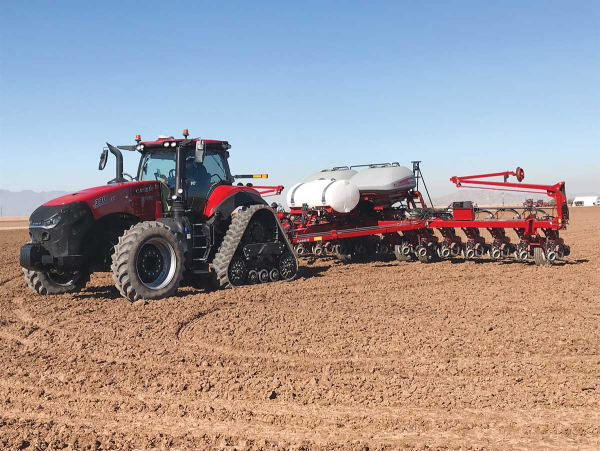
Looking at seeding in more detail, crops of the future will be treated on a seed by seed precision basis. This will include Advanced Seed Delivery that ensures seeds are accurately delivered, spaced and covered for uniform germination. Alongside this, Individual Row Unit Hydraulic Pressure will ensure each seed is planted at the optimum depth. Meanwhile, Prescription Variable Seed and Fertiliser Rate Control will address soil and topography differences in individual paddocks.
Looking more closely at fertiliser and spraying applications, the future will also include Auto Guidance and Automated turns, Row Vision Guidance for hands-free row crop steering up to 20km/h. Vehicle-to-vehicle job synchronisation will ensure minimal overlaps when multiple machines are operating in the same paddock.
In the spraying arena, the likes of Hawkeye II technology will allow the individual control of up to 109 spray nozzles and boom widths of over 135 feet. This will allow improved spray coverage, the avoidance of under or over spraying, greater productivity and reduced input costs. Automatic Boom Levelling will ensure accurate application alongside reduced operator fatigue, while Direct Product Injection via the Sidekick Pro system will offer the elimination of pre-mixing, no unused product and much greater flexibility when moving between different crops.
With so much to offer, Rural News will take a more in-depth look of these technologies over coming issues.