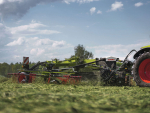
Forage harvesting manufacturer, Claas recently announced several improvements to its JAGUAR 900/800 forage harvesters.
These include the introduction of a newly developed GPS steering guidance and an automatic reel speed adjustment system for pick up headers.
All 2023 delivery models will be available with the CEMIS 1200 operating terminal, which incorporates the newly developed GPS Pilot automated steering guidance and Cemos Auto Performance machine optimisation systems.
Guidance and optimisation systems are activated via a simple, two-step process using the CMotion control lever. After turning and entering the next track, the operator activates the steering guidance system and accelerates up to operating speed. A second push of the button activates the Cemos Auto Performance function to takes control of ground speed and engine output according to crop flow.
“In simple terms, ground speed is reduced when the volume being harvested increases, while engine output is reduced if the volume harvested decreases,” explains Claas Harvest Centre product manager – Jaguar, Luke Wheeler.
Claas claims the system can improve throughput by up to 7%, while reducing fuel consumption by 12%. The manufacturer’s proven Auto Pilot, sensor-based and Cam Pilot, camerabased guidance systems and the Cruise Pilot, automatic speed control system, are also available.
2023 pick-up header fronts can also be specified with automatic reel speed adjustment and automatic lubrication systems. Introduced in 2021, the optional hydraulic drive enables the reel speed to be matched to ground speed independently of the speed of the intake auger.
This means the rotational speeds of the pickup reel and intake auger can be matched exactly to the prevailing harvesting conditions for more consistent crop flow and higher throughput.
This is said to be particularly important when harvesting high yielding crops at low speeds or vice versa.
Studies in the US have shown the new hydraulic drive can increase throughput by up to 13.7%, compared with the existing mechanical constant drive, in heavy harvesting conditions.
“If the ground speed or the set chop length is changed, the speeds of the pick-up reel and intake auger are automatically matched to the prevailing conditions,” Wheeler adds.
“This results in an even more consistent crop flow through the harvester, especially where there are frequent and significant changes in swath thickness. If necessary, both speeds can also be adjusted manually from the cab by the operator.”
Pick up headers can also be equipped with an optional automatic chain lubrication system on the left-side drive of the intake auger and reel.
Meanwhile, Claas has also announced the introduction of a new flagship model for its Jaguar 800 forage harvesters. Already established in the North American market, the 880 is powered by the highly efficient Mercedes- Benz OM 473 LA six-cylinder 15.6-litre engine, with a maximum output of 653hp.
Equipped with Stage IIIa/Tier 3 emissions control technology and the Dynamic Power engine management system that automatically adjusts the engine output to load, delivering fuel savings of up to 10.6%.
The Jaguar 880 can also be equipped with the MCC roller corn cracker with a sawtooth profile or the MCC Shredlage cracker for efficient processing across a range of chop lengths.