
Pouarua Water Storage Scheme Gets Government Backing
The Government is backing work on a community-led water storage scheme that could irrigate up to 11,000 more hectares of the Poverty Bay flats, Agriculture Minister Todd McClay says.




 increase font size
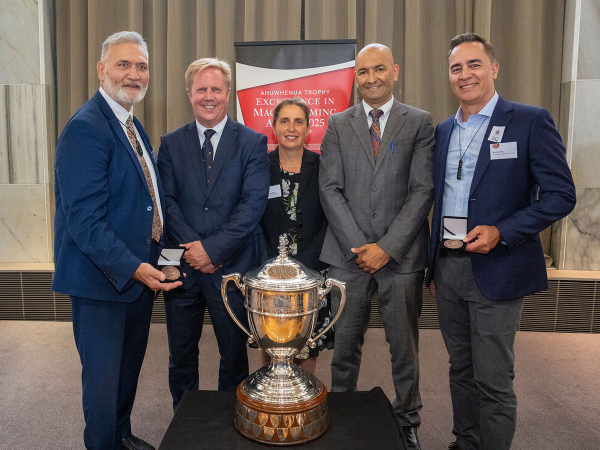 Lester White, chair Tawapata South Māori Incorporation Onenui Station,Todd McClay, Nukuhia Hadfield Tama Potaka, and Morris Pita, co chair Whangaroa Ngaiotonga Trust. Photo Credit: Alphapix
Maori farms from Northland and Northern Hawkes Bay are the finalists in this year’s prestigious Ahuwhenua Trophy competition for the top Maori sheep and beef farm.
The two are Whangaroa Ngaiotonga Trust and Tawapata South Māori Incorporation Onenui Station.
The announcement of the finalists was made by the Minister of Agriculture, Todd McClay at a function in parliaments Beehive on Wednesday February 19.
The event was attended by more than 100 people including politicians, diplomats, Maori and primary industry leaders and the finalists and their whanau.
Whangaroa Ngaiotonga Trusts property, is situated near the coastal settlement of Whangaruru, about an hour’s drive north of Whangārei. The actual farm takes up about a third of the 1,100ha’s of land owned by the trust and on it they finish about 1000 bulls. There is also 297 ha’s of forestry and 433 ha’s of native forest and wetland.
Tawapata South Māori Incorporation Onenui Station is located at the tip of the Māhia Peninsula, Hawke’s Bay and consists of 1,700 hectares is effective farmland. It’s a sheep and beef farming unit wintering 15,000 stock units, including 6,000 breeding ewes, 600 breeding cows, replacements, and trade cattle. The farm finishes 75% of its sheep and 36% of its cattle, with the remainder sold store.
The Ahuwhenua Trophy is the most prestigious award for Māori agriculture and was inaugurated in 1933 by the great Māori Leader, Sir Apirana Ngata and the Governor General at the time, Lord Bledisloe to encourage Māori farmers to improve their land and their overall farming performance.
On a three year rotational basis, the Trophy is competed for by Māori farmers and growers in the sheep and beef, dairy and horticultural sectors. This year the competition is for sheep and beef.
Nukuhia Hadfield, Chair of the Ahuwhenua Trophy Management Committee which runs the competition says it is fantastic to see these excellent finalists who will add to the impressive alumni created by this award.
She says the last few years have been hard for all sheep and beef farmers around the country as they have fought to stay in business against the odds of adverse weather and lower prices, especially for sheep meat.
Nukuhia Hadfield says Māori are intergenerational farmers, meaning that while they want to get their properties up and running as quickly as others, they are equally concerned that any such repairs will be of such good quality as to protect the land for future generations.
“A philosophy that is both practical and sensible, and one that is catching on in the wider agri-sector,” she says.
The finalists will hold a public field day at their respective properties in early April and the winner will be announced at the awards dinner on Friday 6 June in Palmerston North
The Government is backing work on a community-led water storage scheme that could irrigate up to 11,000 more hectares of the Poverty Bay flats, Agriculture Minister Todd McClay says.

A Labour-led Government won’t be bringing back the controversial freshwater rules of 2020.
It was billed as a chance for all the political parties to woo the rural vote, but question marks hang over just how effective this was.
There's been widespread support from the primary sector for the Government's announcement on changes to freshwater farm plans that come under the Natural Environment Bill, which is now set to replace the existing RMA.
The country's second largest milk processor is warning against 'complacency' during a review of competition regulations in the dairy sector.


High country stations, mixed sheep and beef farms, Māori-owned farms, corporates and family operations are among the nine commercial farms taking part in the Livestock Innovation Farming Transformation programme, known as LIFT.
OPINION: New health and safety guidance unveiled by the Government recently provides farmers greater certainty about what is expected of them when managing risks on farm.
The National Animal Welfare Advisory Committee (NAWAC) is seeking public feedback on proposed changes to the Code of Welfare for Rodeos.
A New Zealand initiative supporting farmers to restore the health of grazing landscapes has received international backing through the Regenerative Fund for Nature, a global collaborative fund supporting regenerative agriculture and the communities that produce natural fibres for the fashion industry.
Combine premium New Zealand products, blend in a family ritual and what do you get? A world-class functional drink.
Entries are now open across eleven regions for the 2027 New Zealand Dairy Industry Awards (NZDIA).


OPINION: The same mainstream media muppets that brought you Jacindamania in 2017 have been flat out pimping for the Opportunities…
OPINION: Your old mate reckons the atrocious way farmers in the UK are treated by their lords and masters in…




