NZKGI Responds to Migrant Worker Exploitation Reports
Where any worker in the kiwifruit industry is mistreated, we expect the authorities to take action.




 increase font size
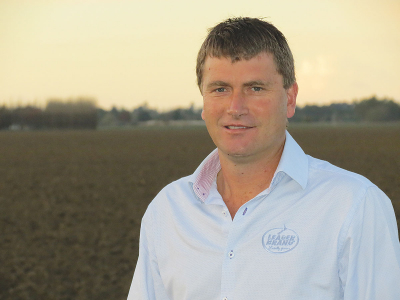 LeaderBrand chief executive Richard Burke.
Ready-to-eat salads are proving a hit with the leading horticultural producer LeaderBrand Produce Ltd.
The Gisborne company has about 3500ha under cultivation at Gisborne, Pukekohe, Matamata and Chertsey, near Ashburton.
The vegetables they grow include broccoli, squash, corn, asparagus, cabbages, spinach, kale, beetroot and lettuce. They deliver fresh to supermarkets and other outlets NZ-wide.
The company employs about 400 full time equivalents.
Chief executive Richard Burke says over the last five-ten years the company has focused on the fresh domestic market rather than exporting, although they export squash to Japan.
Burke says they simply can’t produce at a scale to compete with growers in other countries.
“We saw the challenge with exports such as the moving exchange rate and volatility around global financial issues, so we decided we would focus on the domestic business and we looked for opportunities in that,” he told Hort News.
This led to investing in the salad business which required building a high-spec salad factory in Gisborne, a big outlay including the latest equipment from Europe. The factory was commissioned two years ago and has quickly proved its worth.
“It’s taken the salad business in NZ to a new level of compliance, food safety and quality.”
The whole process is highly mechanised -- from the fields where the ingredients of the salads are grown to the factory.
For example, the lettuces are grown in rows down which a special harvesting machine, attached to a tractor, travels to cut off the leaves at a set level and convey them into crates bound for the salad factory.
Here they are mixed with other ingredients and packed in a sterile environment. The end product is a plastic bag of fresh ready-to-use salad.
A key to the success of the LeaderBrand operation is its smart distribution systems, which can see product harvested in any growing area and shipped overnight for processing in Gisborne and then distributed to supermarkets NZ-wide.
Burke says strict temperature control and a good roading system is pivotal to the success of their operation.
“The importance of the roading network is huge for us and it’s a challenge for us in Gisborne,” he explains.
“The two main roads in and out go to Napier and Whakatane and it’s critical that NZ keeps investing in those roads if the region is going to survive.”
From Gisborne the boxes of salads are quickly freighted to supermarkets.
Other products besides the salad packs are also freighted from the Gisborne hub.
Where any worker in the kiwifruit industry is mistreated, we expect the authorities to take action.

Kiwifruit growers are watchful but remain optimistic as concerns around the potential effects of the El Niño weather pattern this season.
James Blair, an agronomist for AS Wilcox and the Pukekohe regional champion, has won the 2026 Young Grower national title.
Claimed to be the first autonomous robot for New Zealand vegetables growers, the first Kilter AX-1 unit has arrived in the country.
After delivering a strong financial year, rural trader PGG Wrightson says the coming months will depend on customer confidence and weather.


In Dacre, near Invercargill in New Zealand’s South Island, Bruce Dinnington is running a dairy operation unlike any other.

A free online platform aggregating governance vacancies across rural and regional New Zealand has been launched.
Environment Minister Nicola Grigg has announced details of a new rural plastics recycling scheme.
Agricultural drone operators say that a government decision to allow lower-risk drone work without certification won’t lower standards but drive innovation and efficiency.
OPINION: Warning bells are ringing in the arable sector.
Farmgate lamb prices are down by 8%, beef cattle by 4.5% and farm expenditure up by 4.2%.

OPINION: The same mainstream media muppets that brought you Jacindamania in 2017 have been flat out pimping for the Opportunities…
OPINION: Your old mate reckons the atrocious way farmers in the UK are treated by their lords and masters in…