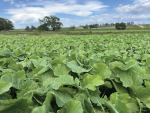
New Reviva Forage Rape Wins Over Dryland Farmers in First Year
It's only just hit the market, but a new forage rape bred for dryland farms has already won the approval of lambs and young cattle both north and south.




 increase font size
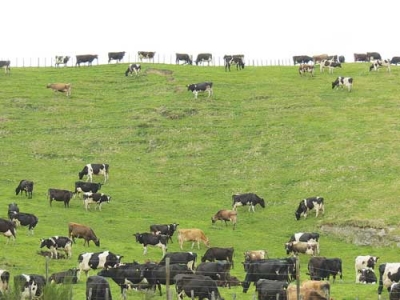 WRC has warned its first sheep and beef farmer for breaching N levels in the Lake Taupo catchment.
Holding on to stock longer after a drought in the hope they would reach higher weights contributed to a Taupo farmer becoming the first sheep and beef farmer warned by the Waikato Regional Council for breaching nitrogen caps.
The unnamed farmer was formally warned for breaching the Resource Management Act (RMA) by exceeding a nitrogen discharge cap on properties in the Lake Taupo catchment over a two year period.
The council’s farming services manager Nicole Botherway told Rural News the farmer tends to purchase weaner heifers late/early in the year (Dec-Jan) and sell them just over a year later at about 18 months old (R2).
During the 2013-14 year the R2 heifers were meant to leave in April-May.
“However, the drought hit in late summer and he held on to the stock in the hope rain would arrive and the cows would be able to reach higher weights,” Botherway says.
“He did not [sell them until] the following January at which stage the [they] had been on the property for over a year. Thus, for almost a year, greater numbers of older (mature, bigger) stock were on the property than proposed. With regard to stocking rates, sheep on the farm were relatively similar to that outlined in the NMP (nutrient management plan).
“The main differences were with cattle. In the NMP all cattle were outlined as being of Angus breed. During the monitoring years more than half of the cattle were Friesian breed. Friesians leach more nitrogen than Angus due to their higher metabolic rate which requires a greater amount of feed being eaten and therefore nitrogen being cycled through the animal’s body.”
It is the first warning issued by Waikato Regional Council under the new Variation 5 consenting regime designed to protect the lake’s health from nitrogen.
The warning came after it was discovered more than a tonne of excess nitrogen could eventually leach into the lake as a result of the farmer’s operations over the two years. By themselves the breaches are not expected to have a major detrimental effect on the lake’s health.
Botherway says this is the first such formal warning by the council and does not know if any other council has handed out a similar warning. There are no other waterways and lakes in the Waikato region to which limits apply for sheep and beef farmers.
Botherway says the case is particularly unfortunate as the farmer has personally been involved in efforts to protect the lake. “He has been open and co-operative, and acknowledged he did not do things properly on the properties concerned,” she says.
However, Botherway says the council will continue to monitor farms and hold people to account if they negligently or deliberately breach resource consents. This is for the health of the lake and in fairness to all those working within their cap.
“It’s a situation where more attention needed to be paid to adhering to the details of the farm’s nutrient management plan. We are serious about protecting the financial investment that Waikato Regional Council, Taupo District Council, Ngati Tuwharetoa and central Government are making in protecting the lake.”
The council’s warning letter to the farmer said the breaches occurred because he did not farm in accordance with his registered nitrogen management plan and failed to inform the council he was deviating from the plan. The breaches totalled an extra 1030kg of potential nitrogen leaching in total.
Botherway says if the council ever decided to prosecute a sheep and beef farmer for breaching nitrogen caps it would be for the courts to determine what penalties were imposed under the penalty provisions of the RMA. She says the court would take into account the circumstances of each case.
It's only just hit the market, but a new forage rape bred for dryland farms has already won the approval of lambs and young cattle both north and south.

When Simon Hales discovered triple drench resistance on his Weber farm, it was a catalyst to fast-track farm system change.
Ravensdown has reported a net profit before tax and rebate of $50.1 million for the year ended 31 May 2026.
OPINION: Could beef cows play an increasingly important role in improving profitability and resilience on hill country farms?
Building a strong team is one of the biggest drivers of a successful sheep and beef business, but it can also be one of the tougher parts to get right.



Alliance is calling for final applications for its 2027 Graduate Programme, with applications closing on Sunday 25 October.
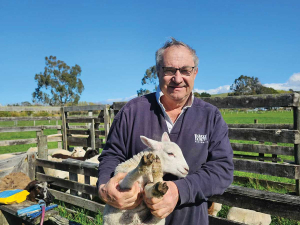
Decades piloting planes has ensured vet and farmer David Hayes is focused on safety. So, after a serious accident while welding on farm, he is sharing his experience so others can learn from it.
Canterbury milk processor, Synlait Milk has confirmed Leon Fung as its chief executive officer.
OPINION: Making it easier to collect rainwater and use it to grow crops and livestock is a no brainer.
As part of its Election 2026 coverage, Rural News asked political parties how they would help pull the arable sector out of the doldrums. Here's what they said:
Farmers are being encouraged to rethink how they manage waste on farm with the launch of ruralwastesorted.co.nz, a new website bringing together practical tips, real farmer experiences and resources.


OPINION: The same mainstream media muppets that brought you Jacindamania in 2017 have been flat out pimping for the Opportunities…
OPINION: Your old mate reckons the atrocious way farmers in the UK are treated by their lords and masters in…




