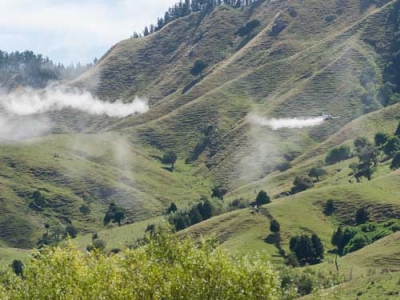
Precision fixed wing aerial fertiliser application on hill country is now a reality, says nutrient cooperative Ballance Agri-Nutrients.
New technology in top dressing planes is set to resolve some of the challenges for farmers relying on aerial application, offering the ability to take precision up a gear.
SpreadSmart is a variable rate application system. This allows different amounts of fertiliser to be applied to different areas of the farm to boost productivity and protect waterways and sensitive areas.
The technology is one of the outcomes of Ballance’s $19.5 million, Clearview Innovations Primary Growth Partnership programme with the Ministry for Primary Industries. The programme aims to improve nitrogen and phosphorus use efficiency and reduce losses to the environment through new products and services for farmers.
Ballance science strategy manager Warwick Catto explains that fertiliser requirements of hill country vary with slope, aspect, stocking rates, soil type and species composition. To get the most out of any fertiliser application and maximise production, different landforms need different treatments. This precision application has not been previously available from a fixed wing aircraft.
“For the first time we now have the technology to apply more than one rate of a fertiliser to better match the fertiliser rate with potential productivity, such as flat areas for finishing versus steep slopes.”
Super Air manager Richard Donnelly says that by using digitised maps and GPS on board the aircraft, his pilots are able to change the application rate in less than a second according to the prescription map and pre-set recommendations.
“When the job is finished we can provide an accurate proof of placement map to the farmer.”
The technology also has safety spin-offs, with the automated system allowing the pilot to focus on just flying the plane.
Super Air has brought out two options to cater for varying farmer needs.
SpreadSmart MyRate takes this technology to the next level and varies the rate of application across the farm to match the unique characteristics of the farm as per the map identifying these areas. It can account for slopes, development areas and exclusion zones, helping to maximise fertiliser spend and farm production by putting the right amount of fertiliser on where it’s most needed.
“It’s an exciting development in an established industry that will offer farmers some real advantages with using fixed wing planes,” says Donnelly.
“It’s definitely the future of topdressing.”