India FTA Removes 33% Tariff on NZ Sheepmeat
New Zealand’s red meat sector has welcomed the India-New Zealand Free Trade Agreement taking effect, which removes India’s 33% tariff on New Zealand sheepmeat.




 increase font size
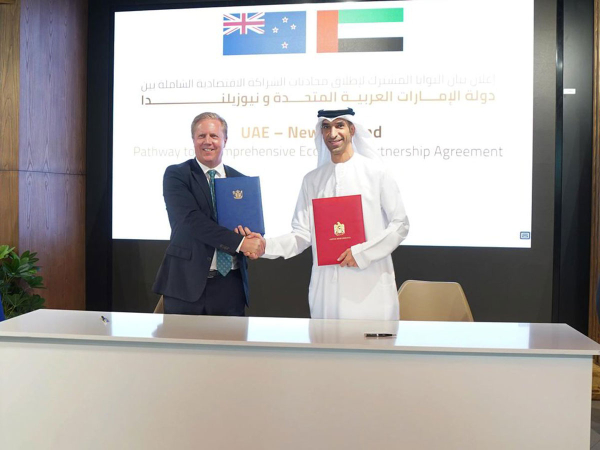 NZ Trade Minister Todd McClay with UAE Minister of State for Trade Thani bin Ahmed Al Zeyoudi. Photo Credit: @toddmcclaymp/Twitter
The red meat sector is welcoming the start of trade negotiations between New Zealand and the United Arab Emirates (UAE).
With the UAE already NZ’s second largest market in the Gulf Cooperation Council after Saudi Arabia, a free trade agreement would further boost exports of frozen beef and lamb and wool.
The UAE is an important market for New Zealand’s red meat sector, generating $47 million of export earnings in 2023. High-value chilled beef is the most valuable export sub-category to the UAE, worth $31 million in 2023, making the UAE New Zealand’s fourth largest chilled beef market behind the US, China, and Japan.
The Meat Industry Association says a high-quality and comprehensive agreement would further open opportunities to increase trade between the two countries.
MIA chief executive Sirma Karapeeva says existing exports to the UAE have been supported by New Zealand’s internationally recognised reputation as a supplier of high-quality halal products and the zero tariff on chilled beef and lamb products.
“A high-quality and comprehensive agreement would open the door to reduce tariffs on other products that we export to the Middle East including frozen beef and lamb, and wool.
“That would represent a boost for our exporters, particularly as our industry looks to support the Government to meet its goal of doubling the value of New Zealand’s exports over the next decade.”
Beef + Lamb New Zealand chief executive Sam McIvor said the UAE is among the world’s wealthiest economies.
“There is increasing demand in the market for the high-quality, safe, sustainable, and nutritious products that the sector produces.
“What has underpinned the success of our export strategy over the last couple of decades has been to have as many open markets as possible, so we have options for capturing the highest price possible for all cuts for our farmers.
“Not only will our farmers and exporters benefit from such an agreement, we know that export growth benefits all New Zealanders so its critically important that a comprehensive agreement succeeds.”
Trade Minister Todd McClay, who is in Dubai this week, announced yesterday that New Zealand and the UAE will commence negotiations on a free trade agreement (FTA).
McClay met with his counterpart UAE Trade Minister Dr Thani bin Ahmed Al Zeyoudi in Dubai, where they announced the launch of negotiations on a Comprehensive Economic Partnership Agreement (CEPA) and discussed strengthening economic ties between New Zealand and the UAE.
“The UAE is an important bilateral partner for New Zealand, and today’s launch of negotiations is an exciting step towards growing our significant trade and economic relationship” McClay says.
This follows the conclusion of successful exploratory discussions, as well as public consultation, which demonstrated the importance of pursuing a high-quality agreement to boost our economy and unlock greater export opportunities.
New Zealand’s red meat sector has welcomed the India-New Zealand Free Trade Agreement taking effect, which removes India’s 33% tariff on New Zealand sheepmeat.
As part of its Election 2026 coverage, Rural News asked political parties how they would help pull the arable sector out of the doldrums. Here's what they said:
Food and fibre exports have returned a billion- dollar bonus to the country.
The Government is backing work on a community-led water storage scheme that could irrigate up to 11,000 more hectares of the Poverty Bay flats, Agriculture Minister Todd McClay says.
The red meat sector is in great heart.


Federated Farmers has welcomed new rural policies released by ACT, saying they align closely with its own election priorities.
Rural Contractors NZ says proposed changes to land transport rules for agricultural vehicles are a welcome response by the Government to out of date regulations which have seen members hit with huge fines.
Alliance is calling for final applications for its 2027 Graduate Programme, with applications closing on Sunday 25 October.
Decades piloting planes has ensured vet and farmer David Hayes is focused on safety. So, after a serious accident while welding on farm, he is sharing his experience so others can learn from it.
Canterbury milk processor, Synlait Milk has confirmed Leon Fung as its chief executive officer.
OPINION: Making it easier to collect rainwater and use it to grow crops and livestock is a no brainer.


OPINION: The same mainstream media muppets that brought you Jacindamania in 2017 have been flat out pimping for the Opportunities…
OPINION: Your old mate reckons the atrocious way farmers in the UK are treated by their lords and masters in…




